










Business Email Is No Longer Just an Email Tool
Business Email has become one of the most critical components of modern digital infrastructure. Yet many organizations still view email as nothing more than a tool for sending and receiving messages, overlooking the security risks that come with it.
Imagine arriving at work on a Monday morning only to discover that your company’s entire email system is suddenly inaccessible.
The sales team cannot send quotations to customers. The finance department cannot receive invoices from suppliers. Employees are unable to verify their identities to access internal systems. Even worse, many users lose access to CRM, ERP, and other business platforms because email now serves as the primary authentication method for most digital services.
A single Business Email security incident can disrupt an organization’s entire operation.
This is why Business Email has evolved far beyond a communication tool. It has become a critical layer of enterprise infrastructure. Unfortunately, many organizations still underestimate the importance of Business Email security until an actual incident occurs.
So what are the most common Business Email security gaps that companies often overlook?
1. Email Has Become the “Master Key” to Your Entire Business System
In many organizations, a single email account can unlock access to dozens of business systems. From CRM and ERP platforms to cloud storage, accounting software, company websites, and marketing applications, email is commonly used for authentication, password recovery, and identity verification.
This means that once an email account is compromised, attackers can gradually gain control over the organization’s entire technology ecosystem by exploiting password reset functions.
What makes this even more concerning is that many businesses still have not implemented essential security measures such as Multi Factor Authentication (MFA), login device management, or abnormal login alerts. As a result, the impact extends far beyond the loss of one mailbox. It can quickly escalate into a disruption affecting the entire business operation.
In other words, Business Email is no longer just another application. It has become the gateway to nearly all of an organization’s digital assets.
When Business Email becomes the connection point for every business system, protecting email also means protecting enterprise data, business operations, and organizational continuity.
2. Business Email Impersonation Is Becoming Increasingly Difficult to Detect
In the past, phishing emails were often easy to identify because they contained spelling mistakes or obvious formatting issues. Today, however, email impersonation attacks have become far more sophisticated.
Attackers can register domains that closely resemble legitimate company domains, copy email signatures, corporate logos, and branding styles to create highly convincing messages. Sometimes, changing just a single character in an email address is enough to deceive employees into believing the message came from a trusted executive or business partner.
For example, replacing the letter “m” with “rn”, or making a minor variation in the domain name, can easily mislead recipients into approving wire transfers, sharing confidential documents, or disclosing sensitive information.
This is one of the most common forms of Business Email Compromise (BEC), a type of cyberattack responsible for billions of dollars in financial losses worldwide every year.
The root cause is not always advanced hacking techniques. In many cases, organizations simply have not configured essential email authentication standards such as SPF, DKIM, and DMARC, all of which help verify legitimate email sources and reduce the risk of domain spoofing.
A successful Business Email impersonation attack affects far more than financial losses. It can severely damage brand reputation and erode customer trust.
In many cases, attackers exploit weaknesses in security processes and employee awareness rather than vulnerabilities in technology itself.
3. Business Email Data Is Fragmented and Difficult to Control
Another overlooked risk is that Business Email management often depends entirely on individual employees.
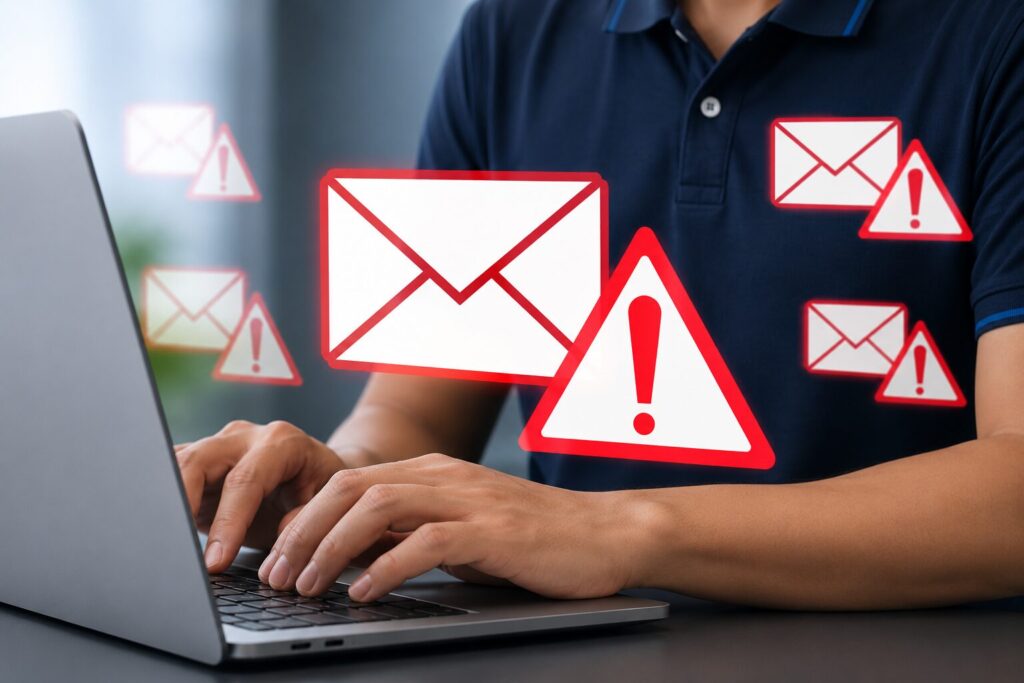
Each employee stores emails in their own mailbox. There is no centralized backup strategy and no standardized handover process when employees leave the company. As a result, valuable business information such as contracts, quotations, customer communication history, and important business decisions often disappear with individual accounts.
In reality, many organizations fail to recognize that email data is a valuable business asset. When an employee resigns, the complete history of customer conversations may disappear as well.
Beyond creating operational difficulties, this fragmented approach significantly increases security risks while making it much harder to comply with future data retention, auditing, and regulatory requirements.
Business Email is not merely a communication tool. It is part of an organization’s information assets. Without centralized management, data loss becomes a matter of time rather than possibility.
How Can Businesses Build a Secure Business Email System?
When discussing Business Email Security, many organizations immediately think about creating stronger passwords or requiring employees to change their passwords regularly. While these practices are important, they represent only a small part of a much broader security strategy.
A secure Business Email system should be built using multiple layers of protection, covering user authentication, access control, data management, and continuous monitoring. The objective is not only to prevent external cyberattacks but also to minimize operational risks caused by internal security gaps.
Key security measures every organization should implement include:
- Enabling Multi Factor Authentication (MFA) to reduce the risk of compromised user accounts.
- Configuring email authentication standards such as SPF, DKIM, and DMARC to prevent domain spoofing and Business Email impersonation.
- Centralizing user account management with role based permissions, allowing administrators to quickly revoke access whenever employees leave the organization.
- Encrypting Business Email data during both transmission and storage.
- Continuously monitoring login activity, detecting unusual access attempts, and generating real time security alerts.
- Establishing centralized backup and retention policies to ensure Business Email data remains protected, recoverable, and available whenever needed.
When these security layers work together, Business Email becomes far more than a communication platform. It becomes a secure foundation for an organization’s digital infrastructure.
Free Email vs Business Email: What’s the Difference?
| Criteria | Free Email | Business Email |
|---|---|---|
| Email Address | @gmail.com, @yahoo.com, etc. | @yourcompany.com |
| Brand Identity | Uses the provider’s branding | Reinforces your company’s professional brand and builds customer trust |
| User Management | Managed individually by each user | Centralized administration with account creation, suspension, and access control |
| Security | Basic security features | Supports MFA, SPF, DKIM, DMARC, encryption, and multiple enterprise security layers |
| Data Management | Data is stored separately in individual accounts | Centralized storage, backup, search, retention, and account transfer |
| When Employees Leave | Email history and business data can easily be lost | Administrators can transfer mailboxes, preserve history, and revoke access immediately |
| Integration | Limited integration capabilities | Integrates seamlessly with CRM, ERP, Calendar, Meeting platforms, and other business applications |
| Best For | Personal users and very small businesses | Organizations that require secure, scalable, and professional operations |
The difference between free email services and Business Email goes far beyond the email address or user interface. More importantly, Business Email offers centralized administration, stronger security, better data governance, and business continuity when employees join, leave, or change roles. This is why more organizations are moving away from consumer email services and adopting professional Business Email platforms that support long term growth, operational efficiency, and digital transformation.
What Should a Modern Business Email Platform Provide?
After understanding the most common Business Email Security risks, organizations should shift their focus from simply choosing an email service to building a secure, manageable, and scalable communication platform.
A modern Business Email solution should provide centralized administration for all user accounts, role based permissions, unified security policies, and complete visibility into account activity. It should also support security standards such as MFA, SPF, DKIM, and DMARC to reduce the risk of Business Email impersonation and account compromise.
Beyond security, integration is equally important. Business Email should not operate as an isolated application. It should connect seamlessly with CRM, calendars, document management systems, online meetings, ERP platforms, and other business applications so information can flow efficiently across departments.
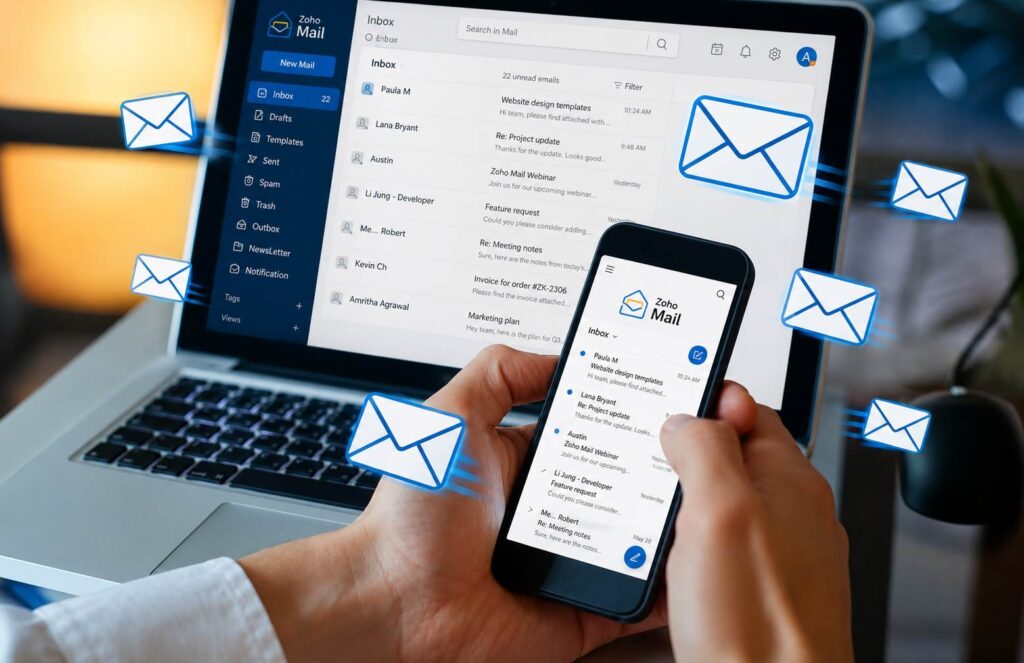
One platform that meets these requirements is Zoho Mail. In addition to providing professional domain based email, Zoho Mail offers centralized administration, multiple layers of security, and deep integration with the broader Zoho ecosystem as well as many third party business applications.
This allows Business Email to evolve from a simple communication tool into an essential part of an organization’s digital workplace infrastructure.
Business Email is one of the most frequently used business applications, yet it remains one of the most overlooked from a security perspective. As email becomes the gateway to identity management and enterprise systems, investing in Business Email Security is no longer optional. It is a fundamental requirement for digital transformation.
If your organization is still relying on traditional email services or has never conducted a Business Email Security assessment, now is the right time to review and strengthen your email infrastructure before expanding into CRM, ERP, AI, or other business systems.
At WBL Group, we do more than implement Zoho Mail. We help organizations build secure digital workplaces by integrating Business Email with CRM, operational workflows, and enterprise management platforms. Our goal is to ensure technology supports daily operations while enabling sustainable business growth.
To learn more, visit wbl.group or contact the WBL team for expert guidance on building a secure, scalable, and future ready Business Email platform for your organization.