










Real Estate Marketing Automation is becoming an essential part of the sales strategy for many real estate businesses. In the real estate industry, customers rarely make a purchase decision after their first consultation. The real difference between businesses lies not only in their ability to generate leads, but also in how effectively they maintain customer engagement throughout the entire buying journey.

Why Is Real Estate Marketing Automation Becoming Increasingly Important?
The cost of acquiring a potential customer in the real estate industry continues to rise. Businesses invest heavily in advertising, project launch events, websites, landing pages, and various marketing activities to attract prospects. However, collecting customer information is only the beginning. What truly determines sales success is the ability to consistently track and nurture customers throughout their decision making process.
Unlike many other industries, real estate buyers often require significant time before making a purchase. They may spend weeks or even months researching projects, comparing locations, evaluating financial options, or waiting for more attractive sales policies. During this period, if a business fails to maintain consistent communication, prospects can easily switch to another project or choose a competitor with a better customer engagement process.
Many real estate companies still rely entirely on their sales teams to remember follow up schedules, monitor customer progress, and reconnect with prospects manually. As the number of leads grows, this approach often results in missed appointments, forgotten prospects, or follow ups at the wrong time. As a result, many valuable sales opportunities are lost despite significant marketing investments.
Real Estate Marketing Automation was designed to solve this challenge. Instead of depending entirely on manual tasks, businesses can create automated customer nurturing workflows that ensure every prospect is consistently engaged while allowing sales teams to focus on consulting clients and closing deals.
Real Estate Marketing Automation Is More Than Sending Bulk Emails
When people hear the term Marketing Automation, they often think about sending mass emails. In reality, email campaigns represent only a small part of a complete marketing automation strategy.
Marketing Automation is the process of creating customer nurturing workflows based on customer behavior and each stage of the buying journey. Whenever a prospect performs an action such as submitting a form, downloading a brochure, registering for a property tour, or opening an email, the system can automatically trigger the next predefined action.
For example, after a customer registers for project information on your website, the system can automatically send a confirmation email, share project brochures, update new sales policies, or notify the sales team to contact the prospect at the most appropriate time. If the customer does not respond immediately, the nurturing workflow continues automatically without requiring staff to manually monitor every individual case.
The key point is that Marketing Automation does not replace sales professionals. Technology handles repetitive tasks such as sending information, scheduling reminders, and segmenting customers. Building trust, understanding customer needs, and closing deals remain responsibilities that only people can fulfill. When these two elements work together, businesses can maintain continuous customer engagement throughout the buying journey without increasing the workload of their sales teams.
How Does Real Estate Marketing Automation Work in a Modern Sales Model?
A modern sales model goes beyond simply collecting customer information and assigning leads to sales representatives. Every piece of customer data should be tracked from the moment a prospect submits an inquiry until the transaction is completed, while each stage of the customer journey includes appropriate engagement activities.
If Marketing only generates leads without a nurturing strategy, the sales team has to start from scratch with every prospect. On the other hand, if Sales lacks customer insights and automated engagement workflows, many opportunities will be lost simply because prospects are not ready to make a decision during the first interaction.
A modern sales model is typically structured as follows:
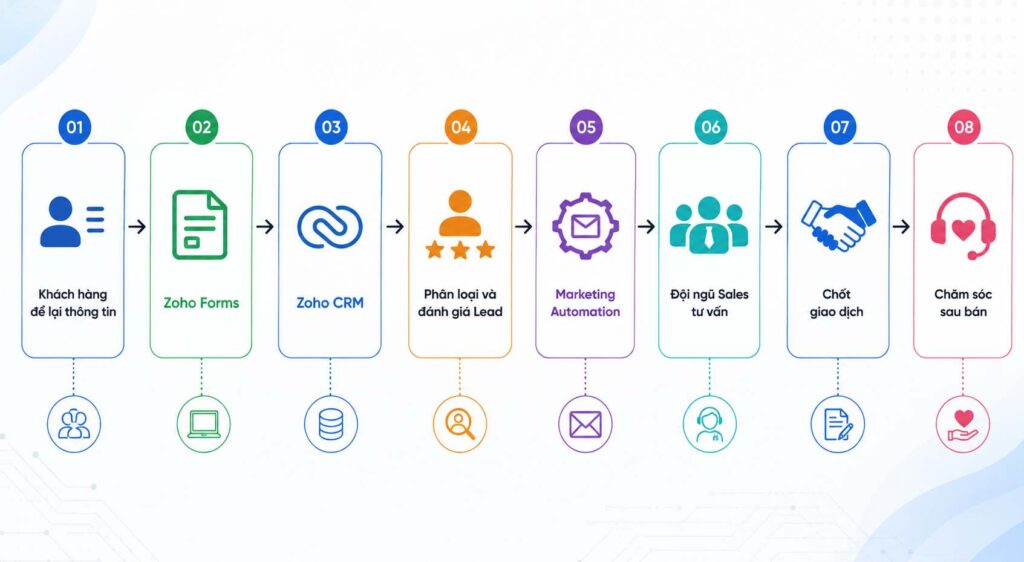
Each stage has its own purpose while remaining connected through a centralized data source. This allows Marketing, Sales, and management teams to clearly understand where each customer is in the buying journey and determine the most appropriate next action.
Stage 1. Lead Capture and Qualification
Every sales journey begins with capturing potential customers. Leads may come from multiple sources, including websites, landing pages, Facebook Ads, Google Ads, TikTok Ads, project launch events, or referral programs. Without centralized data management from the beginning, businesses often face duplicate records, delayed lead assignments, or missed opportunities.
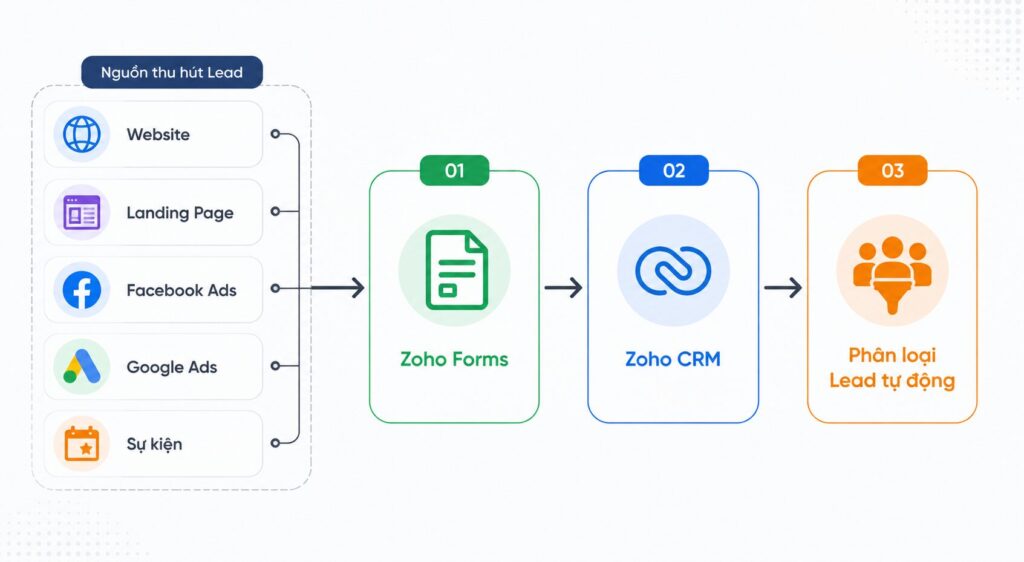
Using Zoho Forms, lead information from every registration channel can be automatically transferred into Zoho CRM. Based on predefined rules, the system automatically categorizes leads by project of interest, location, budget, lead source, or assigned sales representative. This enables sales teams to respond much faster as soon as customer information is submitted.
Stage 2. Nurturing Prospects with Marketing Automation
In real estate, very few customers make a purchase decision immediately after their first interaction. Most need additional time to research projects, compare available options, or evaluate their financial situation. Unfortunately, this is also the stage where many businesses lose potential customers because they fail to maintain consistent communication.
Instead of relying entirely on sales representatives to manually send every email or make every follow up call, businesses can create Real Estate Marketing Automation workflows tailored to different lead segments. Whenever a customer performs a specific action, the system automatically executes the next step based on the predefined workflow.
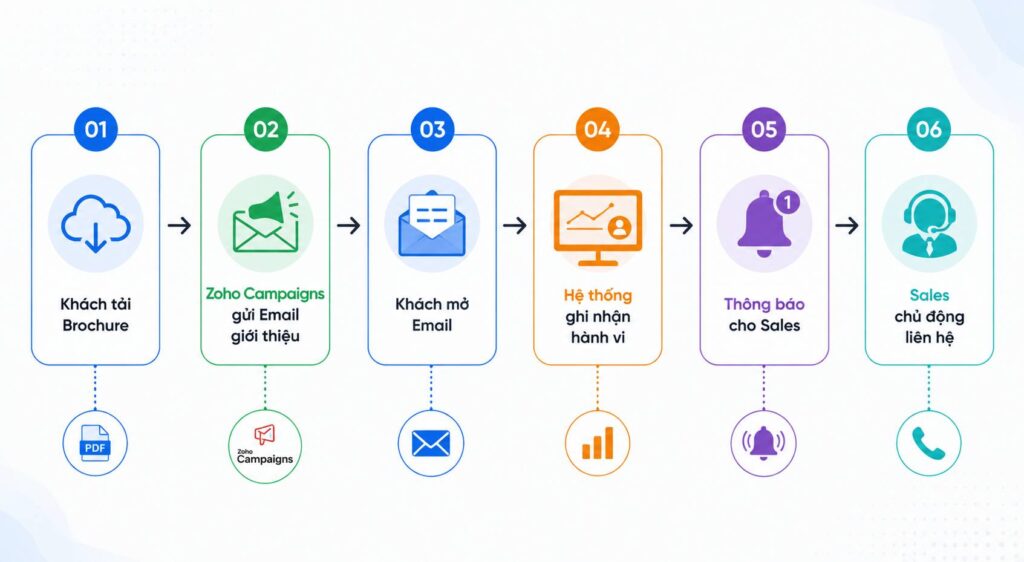
For example, when a prospect downloads a project brochure, the system can automatically send a detailed project introduction, share updated sales policies, or notify the sales team once the customer’s engagement level increases. This ensures continuous customer nurturing while delivering relevant content at every stage of the buying journey.
Stage 3. Sales Consultation with CRM
After prospects have been nurtured through Marketing Automation, the Sales team has access to richer customer insights before beginning the consultation process. Instead of calling customers from a random list, Sales representatives can prioritize prospects who have shown a high level of interest or have recently completed important actions.
CRM does not replace the role of Sales consultants. Instead, it equips the sales team with the information they need before every customer interaction. This allows conversations to be more relevant to each customer’s actual needs, improving both the customer experience and the likelihood of conversion.
CRM supports the Sales team in several ways:
- The complete customer interaction history is stored within a single customer profile, allowing Sales representatives to quickly understand customer needs and review all previous communications.
- The system records customer activities such as opening emails, submitting forms, or changes in opportunity status, providing additional insights that help Sales determine the right time to reach out.
- Managers can monitor the progress of every sales opportunity, evaluate the performance of individual sales representatives, and quickly identify customers who may be at risk of being overlooked.
Stage 4. Post Sales Customer Engagement
Completing a transaction does not mean the customer journey has come to an end. In the real estate industry, customers who have successfully completed a purchase are often more likely to make future investments, refer friends and family, or show interest in upcoming projects.
Marketing Automation helps businesses maintain long term relationships with these customers through preconfigured customer engagement workflows. Instead of reaching out only when a new project is launched, businesses can build an ongoing engagement strategy that strengthens customer relationships and increases customer lifetime value.
Some activities that can be automated include:
- Send congratulatory emails or thank you messages after a transaction is completed.
- Share updates about new projects or exclusive offers for loyal customers.
- Launch customer appreciation campaigns and encourage referral programs.
- Maintain a complete customer engagement history so the Sales team can continue supporting customers throughout future transactions.
Why Combine Zoho CRM and Zoho Campaigns?
One of the most common mistakes when implementing Marketing Automation is using a tool only to send emails or messages without connecting it to a CRM system. As a result, Marketing and Sales continue to operate separately, customer data remains disconnected, and the sales team struggles to track the complete customer journey.
This is one of the most effective approaches to Real Estate Marketing Automation, enabling businesses to synchronize data between Marketing and Sales. By combining Zoho CRM and Zoho Campaigns, businesses can build a seamless process that covers the entire customer journey, from lead capture and customer nurturing to post sales engagement. Zoho CRM serves as the centralized platform for storing and managing all customer data, while Zoho Campaigns supports Email Marketing and Marketing Automation campaigns based on customer segments and different stages of the buying journey.

Information is continuously synchronized between the two systems. When customer data is updated in Zoho CRM, businesses can automatically enroll customers into the appropriate nurturing workflows. Likewise, customer engagement data from email campaigns and marketing activities is synchronized back to Zoho CRM, providing the Sales team with valuable insights to determine the right time to follow up.
This integration not only enables Marketing and Sales to work from the same source of customer data but also creates a seamless customer nurturing process, reducing the risk of missed opportunities and eliminating duplicate follow up activities.
Marketing Automation Is Only Effective When It Starts with the Right Process
Many businesses expect Marketing Automation to improve sales immediately after implementing new software. However, if the sales process has not been standardized, automation simply enables inefficient processes to happen faster.
Marketing Automation is not about sending more emails or creating as many workflows as possible. What truly matters is clearly defining the customer journey, every stage of the sales process, and the responsibilities of each department. Once the process is well structured, technology can effectively support collaboration between Marketing and Sales.
For real estate businesses, a modern sales model is not only about generating more leads. It is also about maintaining strong customer relationships throughout the entire buying journey. This is a key factor in improving conversion rates and optimizing marketing investment over the long term.
At WBL Group, we do not begin with software implementation. We work closely with businesses to analyze their sales process, customer journey, and the collaboration between Marketing and Sales before recommending the most suitable solutions within the Zoho ecosystem.
From Zoho CRM for customer data management and Zoho Campaigns for Marketing Automation to other applications within the Zoho ecosystem, every solution is designed around the business’s actual operational processes rather than applying a one size fits all approach.
If your business is looking to implement Real Estate Marketing Automation in a structured and effective way, WBL Group is ready to support you from standardizing your sales process and designing omnichannel customer nurturing workflows to implementing the Zoho ecosystem, enabling Marketing and Sales to collaborate efficiently using the same centralized customer data.