











A Real Estate Marketing and Sales Dashboard is becoming an essential tool for organizations looking to unify data across Marketing, Sales, and executive leadership. Instead of having each department rely on separate reports, a centralized dashboard enables businesses to track the entire customer journey, measure ROI in real time, and make decisions based on a single source of truth.

How Does a Real Estate Marketing and Sales Dashboard Resolve Internal Conflicts?
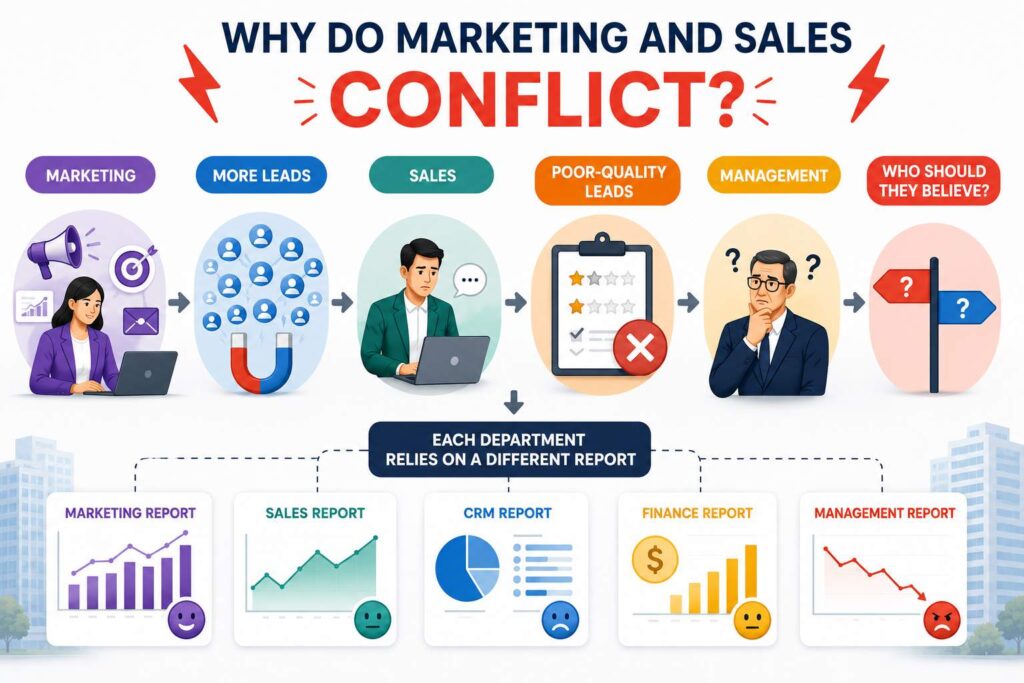
In many real estate businesses, disagreements between the Marketing and Sales teams have become almost routine. Marketing focuses on optimizing advertising costs, generating more leads, and measuring success by the number of leads acquired. Meanwhile, Sales evaluates performance based on appointments booked, project visits completed, and ultimately, successful transactions.
What is interesting is that both teams are correct when viewed from the perspective of their own responsibilities. A campaign may generate thousands of leads at a very low acquisition cost, but if most of those prospects lack the financial capacity or are not suitable for the project, the Sales team still spends significant time qualifying them. On the other hand, Sales may conclude that Marketing is delivering poor quality leads, while the real issue actually lies in the customer nurturing process or slow response times.
When each department relies on a different reporting system, the same data is viewed from different perspectives, making conflicting conclusions almost inevitable. What businesses need is not more reports, but a unified view of the entire customer journey.
ROI Is More Than Advertising Cost Divided by Revenue
When discussing ROI, many businesses focus only on one simple question: “How much revenue is generated from our advertising spend?”
In reality, the answer is far more complex, especially in the real estate industry, where a single transaction may take weeks or even months to complete.
A customer may first discover a Facebook advertisement, submit information through a landing page, receive a call from the telesales team, attend a property launch event, revisit the project multiple times, and only then decide to sign a contract. If data from each of these stages is stored in separate systems, it becomes extremely difficult to determine which marketing channel actually generated the revenue.
This is why many businesses stop at measuring CPL (Cost per Lead) or CPA (Cost per Appointment) without being able to answer a far more important question: Which marketing channel is generating customers who produce the highest revenue and profitability?
ROI should not be viewed as a Marketing metric alone. It is a measurement of the effectiveness of the entire business process, from advertising and customer nurturing to sales consultations, opportunity management, and the completion of successful transactions.
A Real Estate Marketing and Sales Dashboard Creates a Unified Data Source
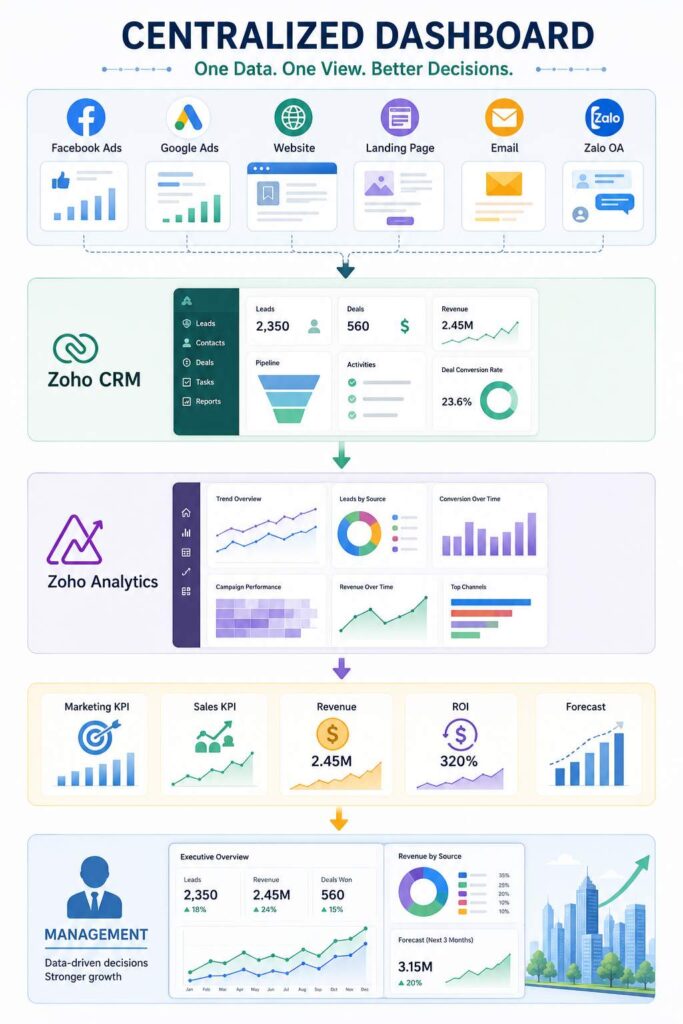
Instead of having Marketing monitor advertising platforms, Sales manage customers in a CRM system, and executives consolidate reports manually using spreadsheets, businesses can build a centralized dashboard that connects all operational data within a single platform.
As a result, every lead can be tracked throughout its entire lifecycle, from the moment it is generated until it becomes a sales opportunity, a completed transaction, or even a returning customer purchasing another property. Key performance metrics such as lead source, marketing costs, conversion rates, revenue, contract value, and ROI are updated continuously in real time.
More importantly, every department works from the same source of data. Marketing no longer reports solely on lead volume, Sales no longer has to estimate lead quality based on personal judgment, and executives can evaluate investment performance using actual business results.
When data becomes the common language across the organization, disagreements gradually give way to decisions supported by clear and objective evidence.
What Should a Real Estate Marketing and Sales Dashboard Measure?
A dashboard should not simply be a collection of attractive charts and graphs. Its real value lies in helping managers quickly answer the most important operational questions.
For example, businesses should be able to identify which marketing channels generate the most completed transactions rather than simply the highest number of leads, which campaigns deliver low acquisition costs with high conversion rates, which Sales teams convert leads more effectively, and which locations, projects, or customer segments generate the highest profitability.
When these metrics are presented clearly within a single dashboard, executives no longer need to wait until the end of the month to review consolidated reports. Instead, they can monitor business performance in real time, respond more quickly to market changes, and optimize budgets before underperforming investments become unnecessary expenses.
A Real Estate Marketing and Sales Dashboard Is Only Effective When Data Is Connected
No matter how well designed a dashboard is, it cannot deliver meaningful value if the underlying data is inaccurate or disconnected.
In many organizations, Marketing data resides in platforms such as Meta Ads or Google Ads, customer information is stored in the CRM system, while revenue is managed through an ERP or accounting software. If these systems operate independently, the dashboard reflects only fragments of the business instead of presenting the complete customer journey.
For this reason, building a dashboard should not be the first step in digital transformation. It is the result of standardizing data and connecting business systems. Only when data is synchronized does a dashboard become a true decision making tool rather than simply a screen displaying numbers.
Zoho Analytics Helps Businesses Build a Centralized ROI Dashboard
For real estate businesses, consolidating data from multiple sources has always been one of the greatest challenges. This is also why many organizations choose Zoho Analytics to build a centralized dashboard that supports business management.
Zoho Analytics can integrate with CRM systems, advertising platforms, financial systems, spreadsheets, and many other data sources to create a unified reporting environment. Executives can monitor revenue by campaign, project, Sales team, or customer source without having to consolidate reports manually.
Beyond executive level reports, businesses can also create dashboards tailored to different roles. Marketing teams can focus on campaign performance, Sales teams can monitor opportunities and conversion rates, while executives can evaluate ROI, revenue, and profitability from the same platform. Each department views the metrics most relevant to its responsibilities while still relying on one centralized and consistent source of data.
WBL Group Supports Businesses in Building Management Dashboards
At WBL Group, we do not begin by asking which software a business wants to use. Instead, we start by understanding the management questions the business needs to answer.
Our consulting team works closely with organizations to analyze Marketing and Sales processes, identify the KPIs that matter most, standardize operational data, and design dashboards that align with their business model. WBL Group then implements solutions such as Zoho CRM, Zoho Analytics, and other related platforms to connect business data into a unified management system.
Our ultimate goal is not simply to create visually appealing dashboards. It is to provide leadership teams with the data they need to make faster, more accurate decisions while reducing unnecessary conflicts between departments. When Marketing and Sales work from the same view of the business, organizations no longer waste time debating who is right. Instead, they can focus on what truly matters: generating more successful transactions and creating sustainable long term business value.