









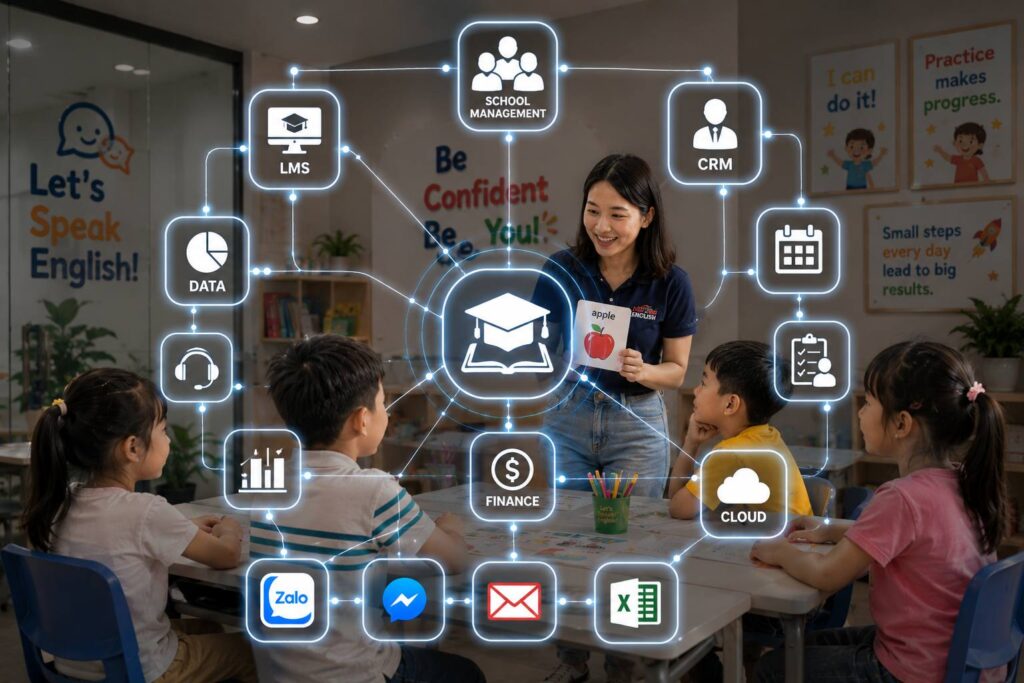
Student data is company property, not the personal asset of individual admissions consultants. However, in many schools and training centers, student data is still stored on personal phones, Zalo, Facebook Messenger, Excel files, or individual email accounts. While this may seem convenient in the short term, it creates significant risks as the organization grows. So, how can educational institutions ensure that their data remains under organizational control, is stored centrally, visualized clearly, and never depends on any individual?
Student Data Is Company Property, Not Just Contact Information
Many educational institutions still consider student data to be nothing more than a list of names, phone numbers, or email addresses. In reality, the true value of student data lies in the entire journey that students and parents have experienced with the institution.
From the first inquiry, consultation history, learning needs, courses of interest, scheduled appointments, follow-up activities, enrollment status, and post-course feedback, every interaction represents valuable data. When this information is stored completely and in a structured way, organizations not only gain a deeper understanding of their students but also have the foundation to optimize admissions, student services, and educational programs.
This is exactly why student data is company property, not the personal data of any individual employee.
What Risks Do Businesses Face When Student Data Is Stored in Personal Accounts?
In practice, many training centers still allow individual staff members to manage student lists using their personal phones or personal Zalo accounts. While this may support daily operations in the short term, it often creates serious challenges over time.
When an employee leaves the organization, communication history with parents may be interrupted or even lost. Leadership teams also face difficulties tracking admissions progress, evaluating student follow-up performance, or transferring students between staff members. Since every employee manages data differently, information becomes inconsistent, difficult to consolidate, and challenging to use for business operations.
More importantly, the organization loses control over one of its most valuable assets: customer data.
Student Data Is Company Property When It Is Centrally Managed
A modern management system does more than simply store data. It clearly defines both data ownership and data access.
All student information should be managed on one centralized platform instead of being scattered across multiple tools or personal accounts. This ensures that even when employees change, all data remains securely stored, work history is preserved, and student support continues without interruption.
This enables organizations to build a stable operating system instead of relying on the experience or memory of individual employees.
Student Data Is Company Property When It Is Visualized on a Centralized System
One of the greatest advantages of a CRM is its ability to visualize data in real time.
Leadership teams can quickly monitor the number of students at each stage of the admissions funnel, conversion rates, the performance of individual admissions consultants, the lead sources generating the highest number of students, and the processing status of every application.
Instead of consolidating reports from multiple Excel files or relying on manual communication between departments, all information is updated within a single system. This enables faster, more accurate, and data-driven decision-making.
Student Data Is Company Property When Access Is Clearly Controlled
Not every employee needs access to all of the institution’s data.
An effective management system should allow access permissions to be assigned based on roles and responsibilities. Admissions consultants should only have access to the students they are responsible for. Team leaders should be able to monitor the performance of their teams. Leadership should have access to overall reports and organization-wide data.
This approach not only protects student information but also reduces the risk of data loss while ensuring that all activities are managed transparently and under proper control.
Digital Transformation Is Not About Changing How Your Team Consults Students. It Is About Changing How Data Is Managed.
Many training centers believe that implementing a CRM means completely changing the way they work. In reality, the purpose of a CRM is not to replace how admissions consultants communicate with students and parents. Instead, it is to standardize how data is stored, shared, and managed.
Employees can continue using familiar communication channels when interacting with students and parents, but all important information should be updated in the centralized system. Once data is managed in one place, educational organizations can build sustainable operating processes, reduce their dependence on individual employees, and establish a solid foundation for future growth.
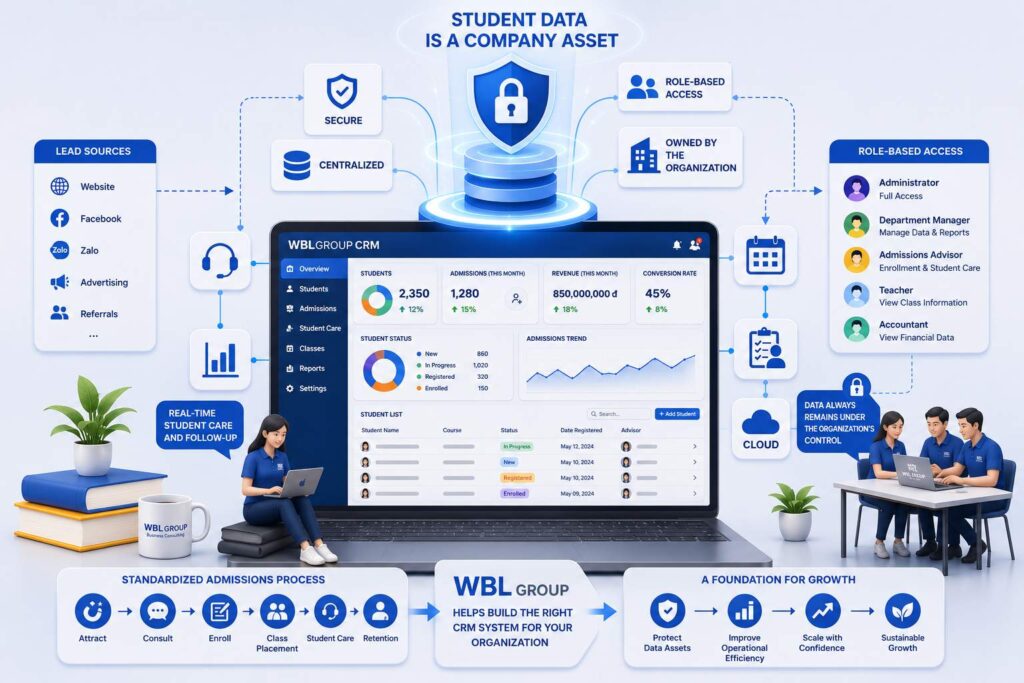
Student data is company property is not simply a management philosophy. It is the foundation for building a sustainable educational organization. When data is centrally stored, visualized through a unified system, and managed with clearly defined access permissions, organizations can significantly reduce operational risks, maintain a consistent quality of student services, and ensure that all information remains under the organization’s control.
At WBL Group, we partner with schools and training centers to build CRM systems that align with their real-world operational models, standardize admissions processes, and manage student data through a centralized platform. This provides educational organizations with the foundation to protect their data assets, improve management efficiency, and confidently scale their operations throughout their digital transformation journey.