











Potential customers do not always disappear because the product is not good enough or competitors offer more competitive prices. In many cases, opportunities are lost in small gaps within the process: a message that receives a response too late, a call that is not made on schedule, or important information that exists only in an employee’s personal account. When these issues repeat at scale, businesses not only lose a deal but also the cost already spent to acquire the customer, the Sales team’s time, and the opportunity to build a long term relationship.

For SMEs, the problem is often not that the Sales team is not working hard enough. On the contrary, the team may be handling dozens or even hundreds of opportunities every month while still struggling to control the entire customer journey. The underlying causes are an unstandardized process and a data management approach that still depends heavily on individual employees.
What “drop off points” are created by an outdated Sales process?
In many businesses, the customer journey is still handled in a fairly manual way. Customers come from advertising, websites, social media or referrals. Employees receive the information, contact customers for consultation and then record notes themselves in Excel, Zalo, Messenger or some other personal tool. When a follow up is needed, the employee sets their own reminder. When managers want to know where a customer stands, they often have to ask each person directly.
This approach can work when the number of customers is still small. But as customer volume increases, gaps begin to appear in the process. There is no single place to know which potential customers are new, which have already been contacted, which are waiting for a quotation and which need to be followed up. Each employee sees only part of the data, while the business needs to see the entire picture.
This is where the three most common drop off points emerge: slow response, failure to follow through, and scattered customer data. Therefore, response speed is not only a matter of how quickly Sales works. It reflects how seamless the potential customer intake and assignment process is.
Mistake 1: Responding to customers too slowly

When a customer actively submits their information, sends a message or requests a consultation, their need is usually at a particular point in time. If the business responds too late, the customer may have already moved on to another option before Sales even starts the conversation.
The gap is often not caused by the employee’s attitude toward work, but by the way the business receives and assigns customers. If Sales has to manually check multiple channels to find new customers, then determine who is responsible and what needs to be done, response time will depend on each individual and each situation.
When the business is still small, one employee may be able to manage a few dozen customers. But as the volume increases, manually checking each channel becomes a bottleneck. New customers may be sitting in an unread inbox, a group chat or a file that has not been updated.
Therefore, response speed is not only a matter of how quickly Sales works. It reflects how seamless the customer intake and assignment process is.
Mistake 2: Providing consultation but failing to follow through
Not every customer makes a decision immediately after the first consultation. Some need more time to think, some need to compare competitors, while others need to wait for the final decision maker.
This is the stage where many opportunities begin to be forgotten.
In the old process, Sales often writes notes such as “call back later,” “waiting for customer response,” or “contact next week.” As the number of customers increases, these reminders can easily get buried among many other tasks. A potential customer who was once highly interested may not receive any follow up for several days simply because there is no clear mechanism for tracking the next step.
The problem is that follow up is treated as something employees need to remember, rather than a required step in the Sales process.

A good process needs to define where the customer stands after each interaction and what the next step should be. If a customer has just received a consultation, the system should record that interaction. If a call back is required in two days, the task should be created and assigned to the right person. This way, customer care no longer depends entirely on Sales’ memory.
Mistake 3: Customer data is in the hands of individual employees

This is the gap with the most long term impact, but it is often only recognized when a problem occurs.
An employee may know their customers very well. They know what has been discussed, which product the customer is interested in and when the customer is expected to make a decision. But if most of that information exists only in a personal Zalo account, Messenger, phone or private file, the business does not actually own the complete data.
When an employee leaves, changes departments or hands over customers, the new person has to start again with whatever information remains. Customers may have to explain their needs again, the conversation history may be incomplete, and the customer care process may be interrupted.
For SMEs, this is not only a data risk but also an operational risk. The more a business depends on the knowledge of individual employees, the harder it becomes to maintain consistent customer service when the team changes.
Customer data needs to belong to the business, not only to the person directly responsible for serving the customer. When an employee leaves, changes departments or hands over potential customers, the new person has to start again with whatever information remains.
Why are SMEs more likely to lose customers as they grow?
A manual process does not usually fail from the beginning. It fails when the business grows faster than the process can be controlled.
When there are only a few customers each day, Sales can remember each case. When the number grows to dozens or hundreds of customers, memory is no longer enough. As the team grows, the way each employee records and processes information also begins to differ.
This creates a paradox: the more potential customers a business has, the more effectively they need to be managed, but the old process becomes harder to control as volume increases.
If the way the business operates does not change, the company may continue spending money to generate new customers while some of the customers it already has are still not being properly followed up.
This is the opportunity cost that is often overlooked in Sales operations.
What gaps in the old process can CRM solve?
CRM does not automatically turn a Sales team into an effective sales organization. The value of CRM lies in creating a shared system that allows the business to manage customers through the same process.
Instead of information being scattered across multiple places, customer data is centralized so the team can view customer information, interaction history and processing status within the same system. Managers can also see which stage a customer is in, who is responsible and which opportunities need to be followed up.
More importantly, CRM helps businesses turn certain tasks that previously depended on employees’ memory into controllable steps within the process. Call back schedules, tasks to be completed, opportunity statuses and next steps can all be recorded and triggered at the right time.
As a result, CRM does not simply help store potential customers.. It helps businesses reduce the gaps in the journey from the moment a customer first shows interest to the moment the opportunity is converted.
Do not just find more customers. Take better care of the opportunities you already have
When conversion rates do not meet expectations, the first reaction of many businesses is to find more customers. Increasing advertising budgets, opening additional sales channels or creating more customer acquisition programs can all generate new opportunities.
But if the process behind them still contains gaps, generating more customers only increases the amount of data that needs to be handled.
Before looking for ways to acquire more potential customers, businesses should review a few basic questions: Are new customers receiving a response quickly enough? Is there a specific follow up step after consultation? Can managers see all opportunities currently being handled by Sales? If an employee leaves, can the business continue serving their customers?
If the answer to any of these questions is no, the problem may not be the number of customers but the way they are being managed.
Customers do not always leave because the product is unsuitable or a competitor offers a better price. In many cases, opportunities are lost in small gaps within the process: a message that receives a response too late, a call that is not made on schedule, or important information that exists only in an employee’s personal account. When these issues repeat at scale, businesses not only lose a deal but also the cost already spent to acquire the customer, the Sales team’s time, and the opportunity to build a long term relationship.
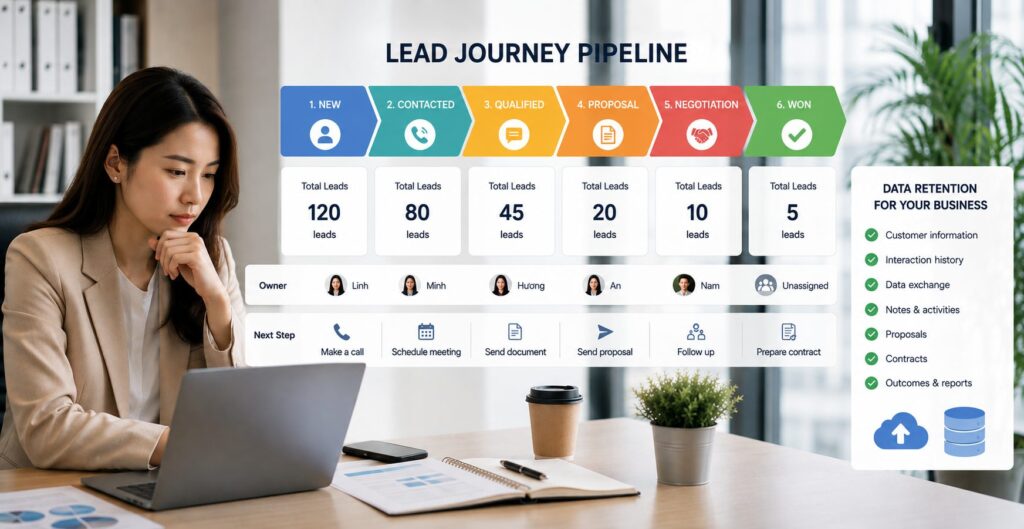
Therefore, effective potential customer management is not simply about knowing how many customers the business has. It also means knowing where each customer is in the journey, who is responsible, what the next step is, and whether the data is being fully retained by the business. A clear process combined with the right management system can reduce reliance on individual memory, minimize information loss and provide better control over every sales opportunity. Businesses do not always need more customers. Sometimes, the first thing they need to do is stop letting the customers who have already found them fall out of the process.
If your business has many potential customers but conversion rates are still below expectations, WBL Consulting Group works with businesses to review Sales processes, standardize data management and build a CRM system that fits their actual operations. Start by identifying where customers are “falling out” of the process before continuing to invest in finding more new customers.