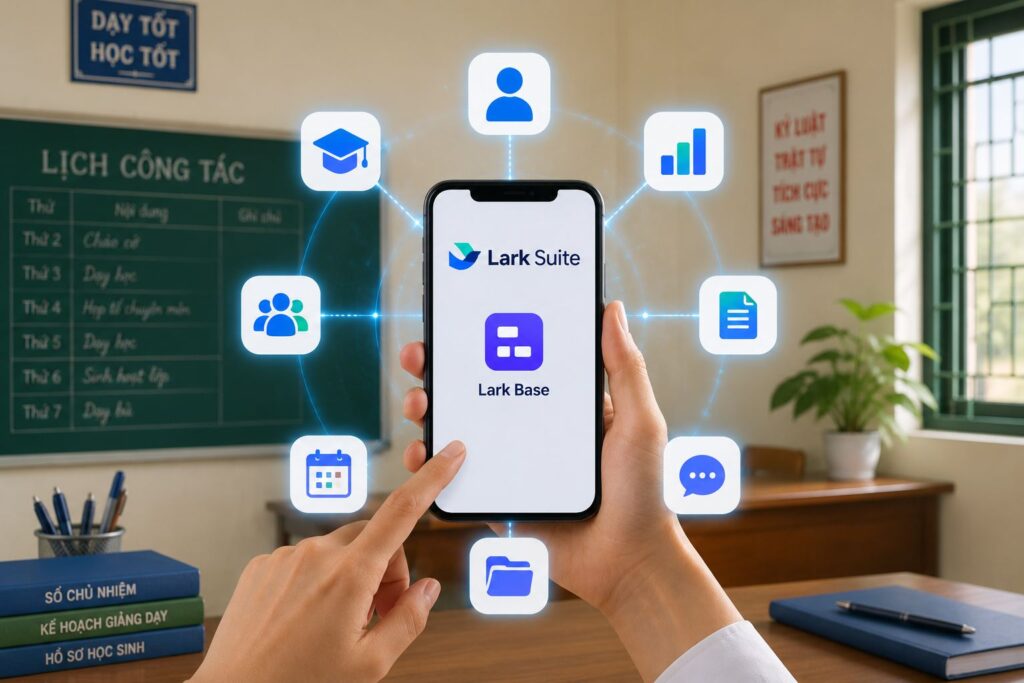










Digital Transformation in Education is not simply about moving the admissions process online or replacing paperwork with software. Its greater value lies in creating a connected experience throughout the entire student and parent journey, where every interaction is captured, connected, and continuously improved. When data is centrally managed, educational institutions not only operate more efficiently but also build long-term relationships that continue for many years after students graduate.

Digital Transformation in Education Does Not Begin with Technology
For many years, when discussing Digital Transformation in Education, many schools and educational institutions have focused on implementing student management software, building online portals, or digitizing student records. While these are all important steps, they are not the true essence of digital transformation.
In reality, schools, training centers, and educational organizations need to build an ecosystem that connects the entire journey of both students and parents. Instead of allowing each department to manage its own information separately, data should flow seamlessly across Admissions, Academic Affairs, Finance, Student Services, and the Leadership team. When every department works from the same centralized source of information, the student experience is no longer interrupted at each stage of the journey.
The Digital Experience Does Not End After Enrollment
Many educational organizations invest significant resources in attracting new students but pay much less attention to the experience after enrollment. However, decisions such as registering for another course, recommending the institution to friends, or returning for advanced programs are all shaped by the experiences students have throughout their learning journey.
A complete digital experience typically begins when a prospective student searches for information, registers for a consultation, attends trial classes or experience sessions, completes enrollment, follows class schedules, receives notifications, pays tuition, interacts with instructors, evaluates course quality, and continues engaging with the institution after graduation.
If each stage is managed through separate systems, students must repeatedly provide the same information, parents struggle to monitor academic progress, and administrative teams spend valuable time consolidating data. On the other hand, when every interaction is connected through a single platform, the entire journey becomes seamless and more convenient for everyone involved.
Both Students and Parents Need a Personalized Experience
Digital Transformation in Education is not only focused on students but also extends to parents, especially for K–12 schools, language centers, and skills training institutions.
Parents do not simply want to know whether their children have paid their tuition fees. They also expect timely updates on learning progress, assessment results, class schedules, examination schedules, important announcements, and any changes related to the academic program.
At the same time, students expect a more convenient learning experience, from registering for courses, accessing learning materials, and communicating with instructors to enrolling in future learning programs. A well-designed digital experience not only saves time but also makes students feel supported throughout every stage of their learning journey.
CRM Connects the Entire Student Lifecycle on a Unified Platform
If the Student Lifecycle is viewed as a journey that spans many years, then a CRM serves as the platform that captures every interaction throughout that journey.
From the moment a prospective student first submits their information through the school’s website, a CRM can record the lead source, consultation history, enrollment process, completed courses, academic performance, payment history, support requests, post-course feedback, and even referrals of new students.
As a result, whenever a student or parent contacts the institution, the Admissions or Student Services team has complete context to provide faster and more accurate support. Leadership teams can also monitor key metrics such as admissions conversion rates, re-enrollment rates, student engagement, and the performance of each academic program without having to consolidate data from multiple systems.
The Greatest Value of Digital Transformation Is Building Long-Term Relationships
Across many service industries, the cost of acquiring a new customer is significantly higher than the cost of retaining an existing one. Education is no exception.
A satisfied student may continue enrolling in new programs, recommend the institution to family and friends, share positive learning experiences, and become a valuable advocate who helps expand the school’s learning community. For this reason, Digital Transformation in Education should not be measured solely by the number of admissions applications or the speed of operational processes. It should also be evaluated through the quality of the learning experience and the long-term engagement of students.
When data is used effectively, educational institutions can proactively develop student engagement programs, deliver relevant information at each stage of the journey, and create a personalized experience for every student instead of applying the same approach to everyone.

Digital Transformation Is the Foundation for Sustainable Growth in Education
As learning needs become increasingly diverse and the expectations of students and parents continue to evolve, simply digitizing individual processes is no longer enough to create a competitive advantage.
What educational institutions need is a unified management system where data is connected across every department, teams collaborate efficiently, and every decision is supported by real-time information. At that point, Digital Transformation in Education not only improves operational efficiency but also enhances service quality, increases student satisfaction, and builds long-term trust in the institution.

Digital Transformation in Education is not simply about implementing software or digitizing administrative processes. It is about building a connected ecosystem that links schools, students, and parents throughout the entire learning journey.
When data is connected, experiences are personalized, and every department works on the same unified platform, educational organizations not only improve operational efficiency but also build long-term relationships with learners. This also creates a strong foundation for sustainable growth as the needs and expectations of students continue to evolve.
With extensive experience in consulting and implementing digital transformation solutions for the education sector, WBL Group partners with schools and training institutions to standardize processes, implement CRM systems, manage student information, automate operations, and develop management dashboards. Our goal is not only to optimize internal operations but also to help educational organizations create a seamless, modern learning journey centered around the experience of both students and parents.