











Website has Traffic is a good signal that the business is beginning to attract users to its digital platform. But after getting Traffic, what will the business do with the people who have visited the Website?
This is when the problem shifts from attracting customers to managing customer data. Traffic tells the business how many people are coming to the Website, but it does not yet tell the business who is actually interested, where they came from, what information they have provided or how Sales should continue to follow up with them.

Having Traffic Does Not Mean the Business Already Has Customer Data
Traffic is a good signal. It shows that the Website can reach users through search, advertising, social media or other channels. But a visit only becomes valuable data when the business has a way to record and use it.
Imagine a customer visits a service page, reads the information, looks at the pricing and then leaves. If the Website only measures visits, the business knows that person has visited but has almost no additional information to take further action.
Another customer fills out a Form to request a consultation. If this information is sent to an employee’s personal Email and then manually entered into a file, the business has Data but still does not truly have a management system. The data can be missed, duplicated or not updated as the customer continues to interact.
Therefore, when the Website Has Traffic, the next question should not only be “how can we get more visits?” The business needs to start asking “What Data is that Traffic generating, and how is that Data being managed?”
From Traffic to Data: The Website Needs to Create Information Collection Touchpoints
Not everyone who visits a Website is ready to make a purchase. Therefore, businesses need to create suitable touchpoints where interested users can leave their information once they have a need.
This could be a consultation registration Form, quotation request, registration to receive materials or another action that is suitable for each type of product and service. The goal is not to collect as much information as possible, but to obtain the data needed for the next step of the process.
For example, a business providing solutions for other businesses may need to know the contact person’s name, Email, phone number, company and consultation needs. When this information is recorded directly from the Website, the Sales team can receive the Lead with an initial amount of information instead of having to start again from zero.
This is an important shift: the Website is no longer just a place to generate Traffic, but is beginning to become an entry point for customer Data.
Data Creates Value When It Is Put into the Right Process
Having Data does not mean that a business is managing Data well.
A list of several hundred Emails in Excel may show that the business has a large amount of customer information, but if it does not know which Leads are new, which Leads are being handled by Sales, which Leads have been contacted or which Leads have been lost, that data is still difficult to support business decisions.
As the number of Leads increases, the business needs a place where Data can be centralized and the handling process can be tracked. This is when CRM becomes the logical next step after the Website.
Instead of having Leads from Forms stored separately in Email, the data can be brought into CRM so Sales can receive it, update its status and track the next steps. The business can then begin to see the customer journey instead of simply seeing a list of contacts.
The basic flow can be visualized as follows:
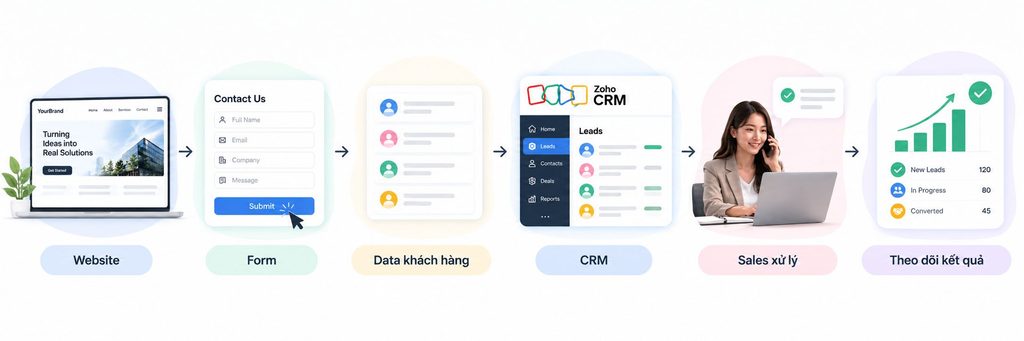
When this process is established, Traffic finally has the opportunity to create business value. The business can not only know how many people visit the Website but also track the number of Leads generated and how the team handles those Leads.
Don’t Just Ask “How Much Traffic?” Ask “What Does the Traffic Generate?”
This is when the business needs to change the way it looks at Website performance.
A Website with high traffic but very few people leaving their information is not necessarily performing effectively. On the other hand, a Website with a moderate amount of Traffic but generating Leads that are a good fit for the product can create greater value. Businesses can use Google Analytics to track user behavior and evaluate Website performance based on actual Data.
When Data is managed centrally, businesses can begin asking deeper questions: Which channels generate the most Leads? Which pages generate the most registrations? Do Leads come from advertising or organic search? How many Leads are received by Sales? How many people move further into sales opportunities?
These questions help businesses move from measuring Marketing activities to evaluating the quality of Marketing activities.
This is also why Website, Marketing and Sales should not be viewed as completely separate areas. The Website creates touchpoints, Marketing generates Traffic and Leads, while the Data management system connects this information with the Sales process.
The Next Step After a Website Is to Build a Data Management System
When the Website Has Traffic, the business has completed an important part of its digital presence. But this is only the beginning of a larger process.
If the Website is where customers enter, then Data is what the business needs to retain from those interactions. When Data is well organized, the business can continue to follow up, segment, measure and make decisions based on actual information instead of relying only on assumptions.
Businesses do not necessarily need to implement a complex system immediately. They can start by identifying what Data needs to be collected, where Leads will be sent, who is responsible for handling them and how the results should be measured. Once the process is clear, the right tool can truly deliver value.
The Website helps the business get found. Traffic shows that people are interested. But Data management helps the business know who those people are and what to do next.
Therefore, when the Website Has Traffic, the next step is not necessarily to continue spending more budget to bring more people in. It is time for the business to look behind the Website and build a Data management process that is strong enough to avoid missing the customers it has already worked hard to attract.