











In the hotel industry, an OTA (Online Travel Agency) is an online intermediary platform that allows travelers to search, compare, and book hotel rooms. Well-known platforms such as Booking.com, Agoda, and Expedia are among the largest OTAs dominating the global market.
Simply put, an OTA functions like an online marketplace for hotels. Instead of visiting each hotel’s website individually, travelers can browse hundreds of accommodation options, compare prices, read reviews, and complete their booking through a single platform.
For hotels, OTAs are an incredibly powerful distribution channel, especially during the early stages of operation or before a property has established strong brand recognition. However, this convenience often creates a level of dependency that many hotels fail to recognize.

How Does an OTA Work?
At its core, an OTA does not own hotel rooms or operate hotels directly. Instead, it acts as an intermediary between travelers and hotels while controlling the most critical stage of the customer journey: where travelers begin their search and make their booking decisions.
The process typically works as follows:
Guest searches for a hotel → Books through an OTA → OTA sends the reservation to the hotel’s system → Hotel provides the service → OTA collects a commission.
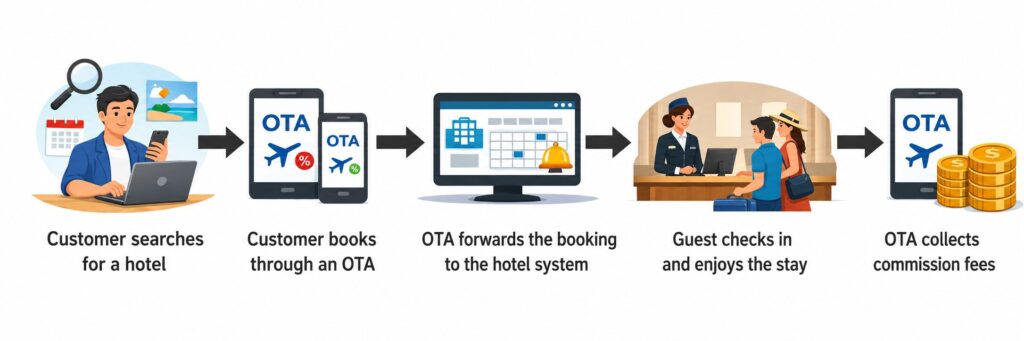
At first glance, the process seems straightforward. However, a closer look reveals an important reality: the hotel only appears at the end of the customer journey, while the OTA controls everything that comes before it.
An easy way to understand this is to think of the OTA as the “storefront” where customers browse and choose products, while the hotel becomes the supplier standing behind the shelves. As a result, hotels rarely know where guests originally came from, how many competing properties they compared, or why they ultimately chose that particular hotel. All of this valuable behavioral data remains inside platforms such as Booking.com, Agoda, and Expedia.
Because OTAs control customer acquisition, they also influence customer acquisition costs. Standard OTA commission rates typically range from 15% to 25%. In practice, however, hotels often lower room rates or participate in preferred partner programs to improve their visibility, pushing the total cost of acquisition to 30–35% per booking.
In other words, for every VND 1 million generated from a room booked through an OTA, a hotel may pay approximately VND 300,000 in OTA commissions before accounting for operational expenses, staffing costs, and service delivery.
This highlights one of the biggest concerns about excessive OTA dependency. Hotels invest in their facilities, operations, staff, and guest experiences, yet still surrender a significant portion of their revenue to intermediary platforms. While hotels bear most of the operational costs and responsibilities, OTAs retain customer access and continue to profit from every completed transaction.
Why Is Relying on OTAs Risky?
1. Revenue Increases, but Profit Does Not
Many hotels assume that a growing number of OTA bookings automatically indicates healthy business growth. In reality, behind those encouraging revenue figures lies another story: a significant portion of that revenue is paid back to OTAs through commissions and related costs.
As a result, hotels may operate at higher occupancy levels and handle greater workloads, while their actual profits fail to increase proportionally. This creates a form of “false growth,” where revenue and booking volume continue to rise, but financial performance and profitability show little real improvement.
2. Losing Control of Customer Relationships
One of the biggest disadvantages of relying heavily on OTAs is that customers do not truly belong to the hotel. Most valuable customer information, including email addresses, booking history, and behavioral data, remains within the OTA platform. This prevents hotels from independently running remarketing campaigns, maintaining post-stay engagement, implementing upselling strategies, or encouraging repeat bookings. As a result, whenever guests return, hotels often have to pay again to “buy back” the very same customers through OTA commissions instead of leveraging the relationship they have already built.
3. Failing to Build a Strong Hotel Brand
When travelers become accustomed to booking through OTAs, they tend to remember the booking platform rather than the hotel itself. Instead of searching directly for a hotel’s name, many travelers search using phrases such as “hotels in Da Nang on Booking.com.” Over time, this positions the hotel as simply another listing within the OTA marketplace rather than a destination customers actively seek out. Consequently, hotels struggle to strengthen brand recognition and build a loyal customer base.
4. Becoming Dependent on OTA Algorithms and Policies
OTAs control almost every aspect of a hotel’s online visibility through search ranking algorithms, promotional programs, and customer exposure. If the platform updates its ranking algorithm or the hotel decides not to participate in promotional campaigns, search rankings can drop immediately, leading to fewer impressions and fewer bookings. In this situation, revenue is no longer fully under the hotel’s control but becomes heavily dependent on the OTA platform.
5. Revenue Is Literally Split in Half
When all costs are taken into account, including:
- OTA commissions
- Discount programs
- Higher operating costs caused by increased booking volume
- The inability to generate repeat business from previous guests
Many hotels ultimately retain only 50–60% of the actual value of each booking. In other words, hotels perform 100% of the operational work while keeping only about half of the value they create.
Are OTAs Bad?
The answer is no.
In fact, OTAs are an important distribution channel in the hotel industry, especially for hotels that need to grow quickly or maximize room occupancy. Through OTAs, hotels can reach a large number of new customers, fill rooms during low seasons, and build initial brand awareness without investing heavily in marketing from the beginning.
The problem is not the OTA itself. The problem lies in how hotels use this channel.
When OTAs are only one part of a hotel’s distribution strategy, they provide significant value. However, when OTAs become the primary channel, or even the only channel, hotels gradually lose control of their customers, their data, and ultimately their profits.
A healthy business should never rely entirely on a single source of customers. OTAs should be used as a tool for growth, not as a foundation that the business depends on.
What Should Hotels Do?
Instead of trying to eliminate OTAs, hotels should focus on reducing their dependence on them. OTAs themselves are not the problem. The real issue is that many hotels have not yet taken ownership of their customer data and customer relationships.
To change this, hotels need a system that can collect, store, and make effective use of customer data. This is where Customer Relationship Management (CRM) becomes an essential platform.
CRM does more than simply store customer information. It helps hotels track booking behavior, manage post stay engagement, run remarketing campaigns, and generate more revenue from returning guests.
When CRM is connected with the hotel’s website, booking engine, and Property Management System (PMS), hotels can gradually build their own direct booking ecosystem. At that point, OTAs continue to play an important role in attracting new guests, but they are no longer the channel that determines the hotel’s entire revenue.
In other words, OTAs help hotels acquire customers, while CRM helps hotels retain customers and increase their lifetime value. Instead of continually paying to acquire the same customers through OTAs, hotels can gradually build direct relationships with their customers through their own data ecosystem.
At WBLGroup, we approach this challenge from a systems perspective. CRM does not work independently. It is connected with the PMS, finance, marketing, and operational processes to create a continuous flow of data throughout the business. Only then can hotels truly take control of their revenue, understand where their profits come from, and identify where improvements should be made.
Conclusion
OTAs are an important part of the modern hotel industry, but they should not become the only channel that generates revenue. Understanding what an OTA is in the hotel industry helps hotels build a more balanced business strategy that combines attracting new guests with developing a loyal customer base.
If revenue continues to grow while profits do not, the problem may not be the market. It may be the way the business system has been designed.
In digital transformation, success is not determined by how many software solutions a business uses. What truly matters is whether the business has full control over its customer data, customer relationships, and revenue.