








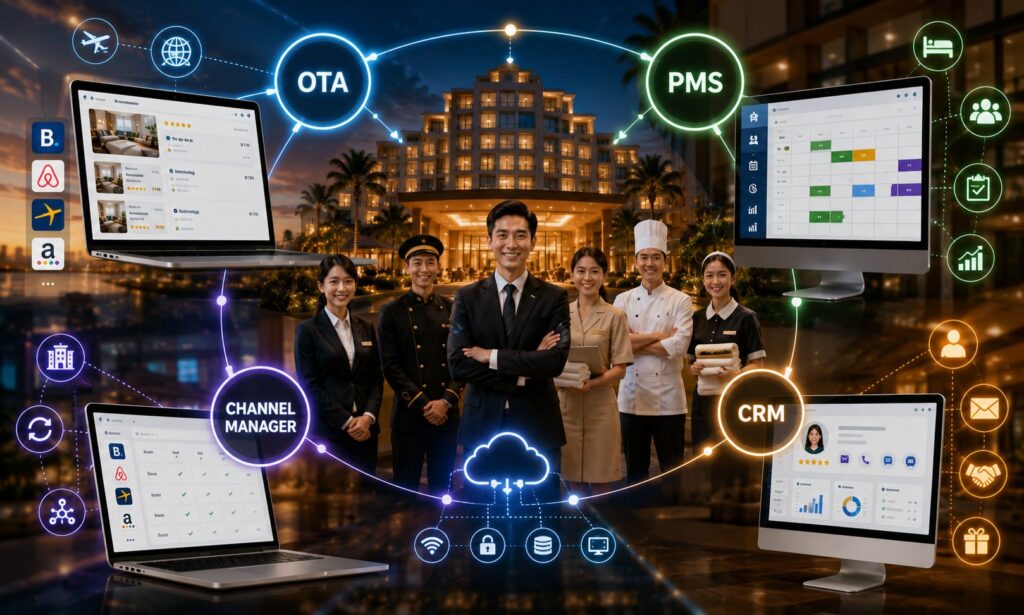
Hotels in the OTA Era have changed significantly compared to the past. A guest can search for a room on Booking, compare prices on Agoda, make a reservation on their phone, and within just a few minutes, the information is transferred to the hotel’s system. But behind a simple booking is an entire chain of technology and people working together. So, from the moment a guest searches for a room until check-out, where does the data actually go? And after the guest leaves, what does the hotel retain beyond the revenue from a single stay?
OTA Has Changed How Guests Search for and Book Rooms
In the past, guests who wanted to book a room would usually visit the hotel’s website, call directly, or send an email. Today, that journey has changed. Many travelers can start by opening a booking app, entering a destination, comparing dozens of hotels, and completing the transaction directly on the platform.
These platforms are known as OTAs (Online Travel Agencies). Simply put, an OTA is like an “online marketplace for hotel rooms”: hotels list their rooms for sale, while guests use the platform to search and choose where to stay.
For hotels, the benefits are clear. Instead of having to find each customer themselves, hotels can appear in front of a large number of people who are actively looking for accommodation. This is particularly valuable for international guests or travelers who have never heard of the hotel brand before, as OTAs significantly shorten the distance between guests and hotels.
But precisely because guests begin their journey on an external platform, hotels need to understand more clearly what happens behind a booking.
A guest books a room through an OTA. What does the hotel need to do next?
Imagine a guest makes a reservation at a hotel through Booking.
As soon as the booking is confirmed, the hotel needs to know which room has been sold, the check-in date, the check-out date, and the information needed to prepare for the guest’s arrival. If the hotel sells rooms through only one channel, this process is relatively simple.
But in reality, a hotel usually appears on multiple platforms at the same time: Booking, Agoda, Expedia, and other channels. At this point, when a room is sold on Booking, the availability needs to be updated to prevent the same room from being sold again on Agoda.
If employees have to open each platform and update the information manually, even a small mistake can lead to overbooking, meaning more rooms are sold than the hotel actually has available.
This is why hotels need a Channel Manager, a system that manages and synchronizes multiple room distribution channels.
What does a Channel Manager do in a hotel?
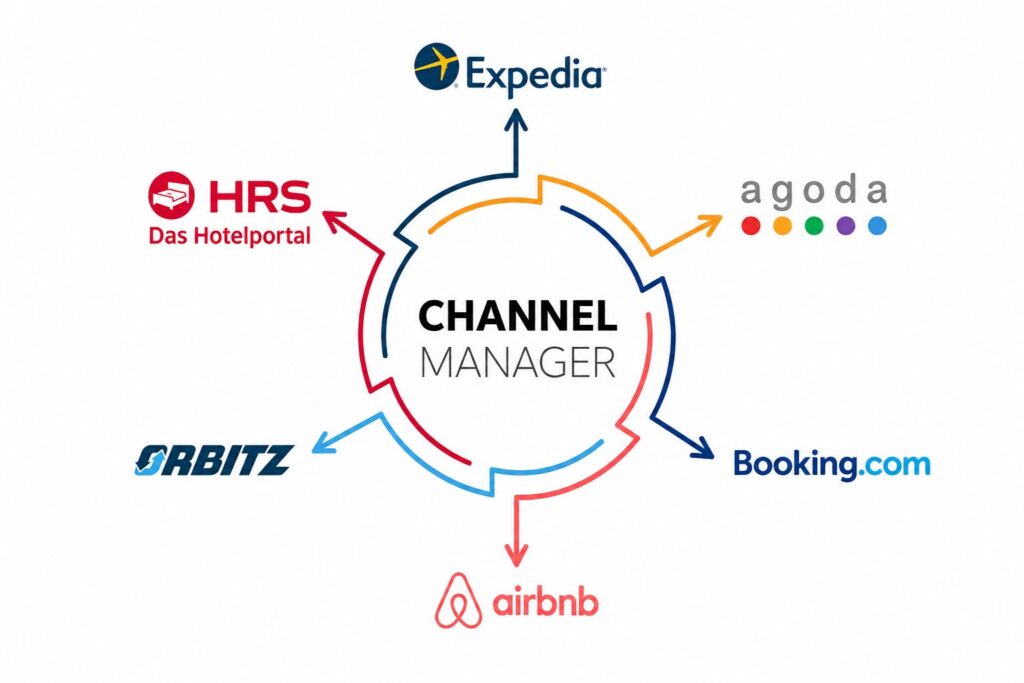
A Channel Manager can be thought of as a “coordination hub” between the hotel and its room distribution channels.
For example, a hotel has 10 Deluxe rooms. When one room is booked on Booking, the system updates the remaining room availability and synchronizes the information across the connected channels. Employees do not have to perform the same action multiple times.
As a result, hotels can reduce manual work, minimize discrepancies in room availability, and manage multiple sales channels more effectively.
However, a Channel Manager only solves part of the problem: bringing booking information from distribution channels into the hotel’s system. After a guest makes a reservation, another entire process still needs to be handled: preparing the room, checking the guest in, monitoring room status, processing payment, and checking the guest out.
That is where the PMS comes in.
What is a PMS and why do hotels need one?
A PMS (Property Management System) can simply be understood as a system that helps hotels manage the activities taking place inside the hotel every day.
Front desk staff need to know which guests are arriving, which rooms are vacant, which rooms are occupied, and which rooms need to be cleaned. The housekeeping team needs to update room status. Managers need to know how many rooms are occupied and the current status of guest stays.
Instead of having each department record information separately or use its own files, this information is brought together into one shared system.
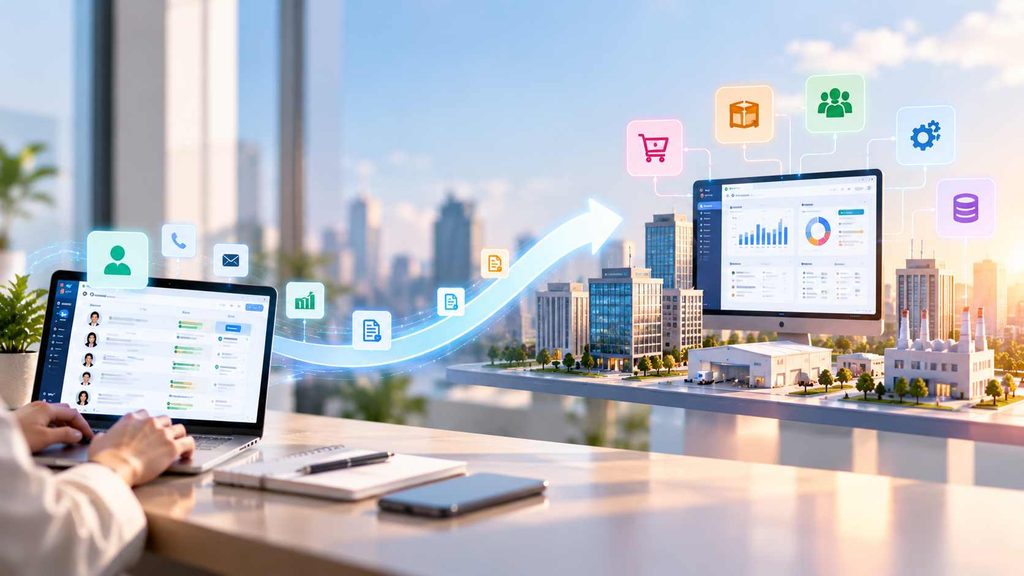
Therefore, if a Channel Manager helps a hotel coordinate room sales across multiple channels, a PMS helps the hotel coordinate its internal operations. The basic flow can be visualized as follows:
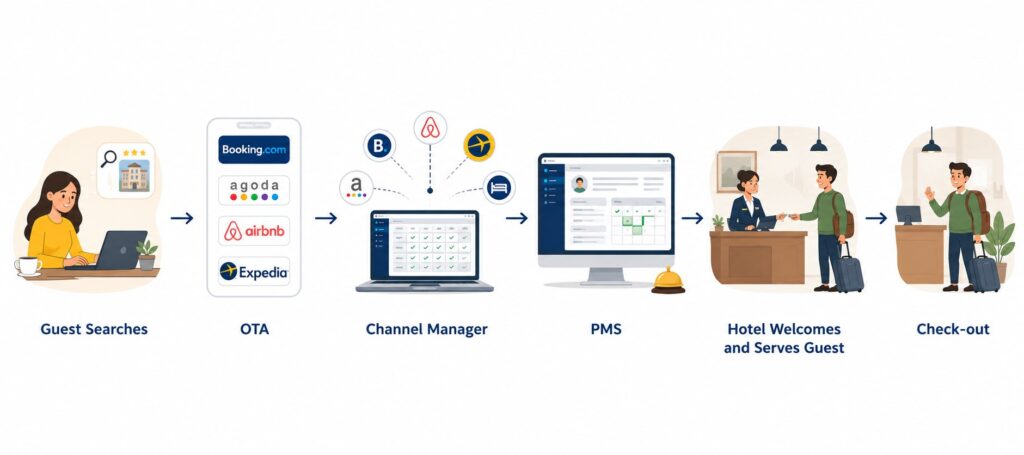
At this point, the entire process of managing a guest stay has essentially been addressed. But there is still a more important question.
After the guest checks out, where does the guest data go?
This is the part that many hotels need to look at more closely. Suppose a guest has stayed at the hotel three times. The first time, they booked through Booking. The second time, they booked through Agoda. The third time, they used another platform.
From the hotel’s perspective, these may appear to be three separate transactions. But in reality, it is one customer who has returned three times.
If the hotel cannot connect the history of these stays, the value of the information becomes fragmented. The business knows that it has sold rooms, but may not realize that the person generating those transactions is actually a loyal customer.
This is the difference between managing an individual stay and managing a relationship with a customer.
Selling a room does not mean the hotel has retained the guest
A guest who books a room today generates revenue for the hotel today. But if that guest returns next year, uses additional services, or refers friends, the value of that relationship is much greater.
To achieve this, hotels need to understand their guests rather than simply know the information associated with a single booking.
For example, a hotel may identify a group of guests who tend to return during the summer. Another group may usually book family rooms and use additional dining services. Business travelers may stay for shorter periods but return more frequently.
Insights like these help hotels make better decisions about customer care, loyalty offers, and marketing activities. Without retaining and connecting this data, every time a guest returns, it is almost like starting the relationship from scratch.
If a hotel already has a PMS, why does it still need a CRM?
PMS and CRM (Customer Relationship Management) do not serve the same purpose. PMS focuses on the question: “How is the hotel operating?”, CRM focuses on the question: “Who are the hotel’s customers, and how is the business building relationships with them?”
A PMS needs to know which guest is staying in which room, when they check in, and when they check out. A CRM needs to know how many times the guest has stayed before, which services they typically use, how they have interacted with the brand, and how the hotel can continue engaging with them.
When the two systems are connected, a guest stay no longer ends at check-out. The information can continue to be used for customer care, marketing, and loyalty programs. This is when operational data begins to become a business asset.
Is OTA a problem for hotels?
No. OTAs remain an important room distribution channel and provide significant value to the hospitality industry. The issue is not whether hotels use OTAs, but how dependent they are on these channels.
If most new guests come from OTAs and the hotel does not have a strategy for building a direct relationship after each stay, the business will have to continually pay to reach customers it has already served.
Conversely, if OTAs are used as a channel for attracting new guests while the hotel simultaneously builds direct booking through its own website, develops loyalty programs, and conducts post-stay engagement, the business can gradually create its own source of returning guests.
The goal is not to “abandon OTAs”, but to ensure that OTAs do not become the end point of the customer relationship.
Hotel digital transformation is not about buying more software
Một khách sạn có thể sở hữu PMS, Channel ManA hotel may have a PMS, Channel Manager, CRM, and many other tools, but still operate inefficiently if these systems are not properly connected.
Before choosing software, businesses need to clearly understand their operational flow:
- Where do guests come from?
- Where is the booking recorded?
- Which system does the information enter?
- Who uses the data?
- Where is the data stored after check-out?
- What does the hotel use that information for next?
Based on these questions, businesses can determine which systems are actually necessary and which systems need to be connected.
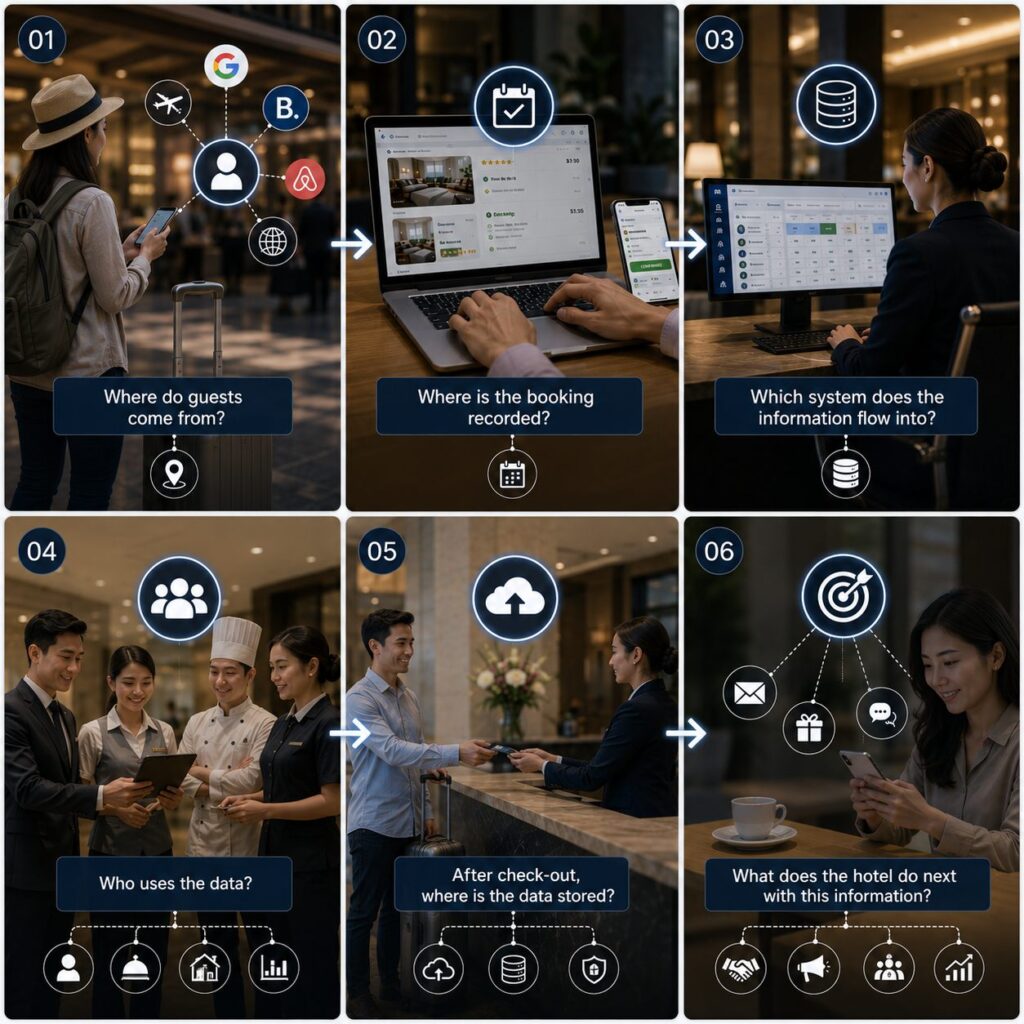
A possible model can be visualized as follows:
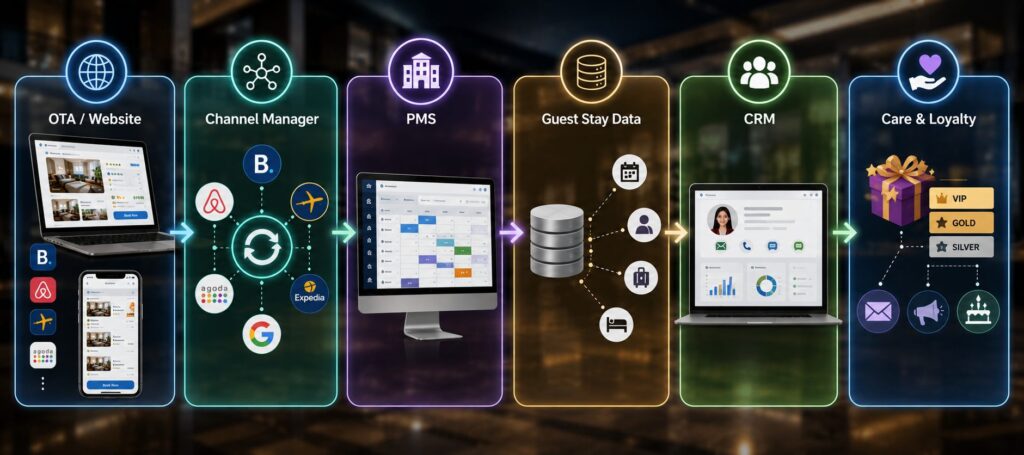
The ultimate goal is not to have as many software systems as possible, but to ensure that the right data reaches the right place, the right person, and the right time.
From selling rooms to building the guest lifecycle
Hotel operations in the OTA era are shifting from managing individual bookings to managing the entire customer journey.
OTAs help hotels reach new guests. Channel Managers help distribute rooms across multiple channels. PMS ensures that the guest stay is managed accurately. CRM helps businesses continue building relationships after guests leave.
When these layers are connected, a booking is no longer just a transaction that generates revenue. It becomes the starting point for the hotel to understand its guests, provide better service, and create opportunities for them to return in the future.
This is also one of the most important challenges of digital transformation in the hospitality industry: not simply operating faster, but turning the data generated throughout the guest experience into long-term value for the business.
See WBL Insight #5: How Do Hotels Operate in the OTA Era?
In WBL Insight #5, WBL Group provides a visual analysis of the entire operational flow behind a single booking, from OTA → Channel Manager → PMS → guest stay, while raising an important question: when guests come from intermediary platforms, how much control does the hotel actually have over its data and customer relationships?
Watch WBL Insight #5 on YouTube to follow the full analysis and better understand how these systems connect throughout hotel operations in the OTA era.
WBL Group works alongside businesses to analyze their processes, connect data, and build technology systems that fit their actual operational needs, with the goal of working smarter, faster, and more efficiently.