








What Is Knowledge Management and Why Do Businesses Need It?
In many businesses, work experience, operational procedures and important instructions often exist only in employees’ minds or are scattered across different storage locations. An experienced employee may know exactly how to handle a specific situation, but if that experience is not documented and shared, others will have to figure things out themselves or ask for the information all over again. When employees leave the company or move to another department, the business also risks losing some of the knowledge accumulated throughout its operations.
This is exactly the challenge that Knowledge Management aims to address. Knowledge Management is the process of collecting, organizing, storing and sharing knowledge within an organization so that employees can access and reuse information whenever needed. This knowledge includes not only official documents but also practical experience, operational guidelines, lessons learned from projects and proven approaches to solving problems.
The key to Knowledge Management is not about storing as many documents as possible, but about turning knowledge into information that can be searched, understood and applied. A procedure only has value when employees know how to access and follow it. A lesson learned from a project only becomes truly useful when other teams can refer to it and avoid repeating similar mistakes.
Therefore, businesses need to treat knowledge as an asset that must be managed, rather than allowing it to depend on individual employees. This also lays the foundation for building a workplace where knowledge can be passed on, helping new employees get up to speed faster and reducing dependence on a few key personnel.
Internal Wiki: Turning Experience into a Shared Asset
One effective way to implement Knowledge Management is to build an internal Wiki. A Wiki is a centralized knowledge repository where businesses can create, update and link information pages by topic. Instead of searching through multiple folders or asking colleagues, employees can access a shared information source to find the guidelines and documents they need.
Unlike conventional storage systems that focus primarily on keeping files, an internal Wiki aims to organize knowledge into content that is easy to read and use. For example, a customer request handling procedure can be presented as a series of specific steps, accompanied by the person in charge, relevant forms and common scenarios. When the procedure changes, the content manager can update it directly so that employees can access the latest version.
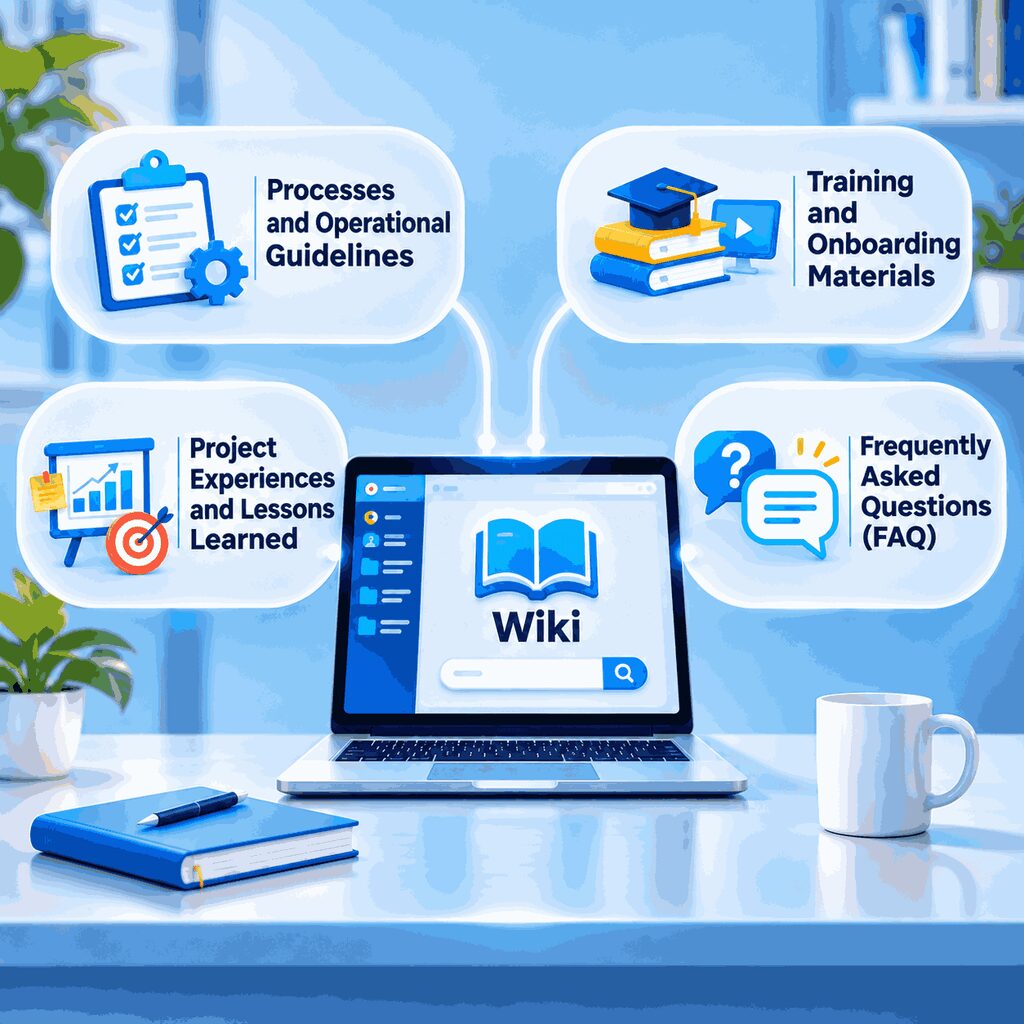
Businesses can start building their Wiki with essential knowledge categories:
Procedures and Operational Guidelines: Document the steps involved in recurring tasks, handling standards and the responsibilities of each position. This serves as an important reference to help employees perform their work consistently.
Training and Onboarding Materials: Compile company introductions, internal policies, system usage guides and the knowledge required for each position. New employees can explore this information independently instead of relying entirely on direct guidance.
Project Experience and Lessons Learned: Record issues encountered, solutions implemented, results and lessons learned after each project. This information helps teams retain and pass on knowledge while minimizing the risk of repeating mistakes.
Frequently Asked Questions: Compile questions that employees commonly ask, together with verified answers. This helps reduce repetitive discussions and ensures consistency in how work-related issues are handled.
Businesses can also refer to Zendesk’s guide to creating an internal knowledge base to learn more about effective content organization and management. This also provides a useful foundation for designing an internal Wiki, making documents easier to find, update and access for employees.
How Does Workplace Support a Knowledge-Sharing Culture?
A Knowledge Management system can only deliver its full value when employees can easily access and contribute information. If documents are stored on a platform separate from their everyday working environment, employees may use it less frequently or continue relying on the habit of asking colleagues directly. Therefore, building a Wiki needs to go hand in hand with the collaborative environment employees already use.
Workplace provides a digital working environment that connects communication, documents and internal collaboration. When combined with suitable Knowledge Management tools, businesses can integrate knowledge sharing into everyday workflows instead of treating it as a separate task.
For example, when a team completes a project, important documents and practical experience can be consolidated into shared reference materials. When employees ask questions while handling their tasks, the person in charge can direct them to the relevant Wiki page instead of explaining everything from the beginning. Frequently used guidelines can also be updated whenever changes occur in procedures or policies.
In addition to storage capabilities, businesses need to pay attention to how content is organized and managed. Each document category should have an assigned owner, a defined scope of use and clear update requirements. Important information should be reviewed periodically to prevent outdated documents from continuing to be used after procedures have changed.
Another point to consider is that not all information should be shared with every employee. Internal documents need appropriate access permissions based on the roles and responsibilities of each department. Content related to finance, human resources or customer information must be managed in accordance with the business’s security policies.
Therefore, Workplace is not simply a place for employees to communicate about work. It can also become an environment that supports the development of habits around searching for, sharing and passing on knowledge throughout the organization.
How to Build a Sustainable Knowledge Management Culture?
Implementing an internal Wiki does not necessarily mean that a business has established a Knowledge Management culture. The greater challenge lies in maintaining content quality and encouraging employees to proactively share their experience. If the system is only updated during the initial phase and then left unused, its documents will quickly become outdated and lose their practical value.
Businesses should start by identifying the knowledge that directly affects their operations. There is no need to upload all documents to the system at once. They can prioritize frequently used procedures, onboarding guidelines and knowledge that currently depends on a small number of individuals. This approach allows the Wiki to deliver practical value early on and makes it easier for employees to adopt.
Next, responsibilities for content management need to be assigned. Each department should have someone responsible for verifying the accuracy of information and updating documents within their area of expertise. The system administration team can take responsibility for organizing the structure, managing access permissions and providing usage guidance, while employees contribute practical experience gained through their daily work.
Businesses should also establish consistent documentation standards. A guideline document should clearly state its purpose, intended audience, implementation steps and contact information for support when needed. Document titles should be easy to understand, content should be categorized appropriately, and update dates should be included so readers can identify how current the information is.
More importantly, knowledge sharing needs to become part of everyday activities. After each project, retrospective meeting or noteworthy incident, teams should develop the habit of recording information that may be useful for future work. Managers need to encourage contributions and create opportunities for employees to reuse stored knowledge.
Effectiveness can be evaluated through specific indicators, such as the time employees spend searching for documents, the number of content updates, the level of Wiki usage and the ability to shorten new employee training time. These metrics help businesses determine whether the system genuinely supports their work or merely exists as a formal document repository.
Turning Knowledge into an Asset That Can Be Passed On
Knowledge Management is not simply about storing documents. It is the process of turning individual experience into a shared knowledge resource that can be searched, shared and used over the long term. When businesses build an internal Wiki on the Workplace platform, information no longer depends entirely on individual employees but is organized into an asset that can be passed on.
To achieve this, technology needs to go hand in hand with content management policies and a knowledge-sharing culture within the organization. When every employee develops the habit of documenting their experience, each department takes responsibility for maintaining its knowledge, and everyone knows how to find information, businesses can reduce their reliance on manual communication while improving collaboration efficiency.

WBLGroup works alongside businesses to assess their current operations, build a Workplace environment and standardize internal collaboration activities, with the goal of developing a well-organized knowledge system that is easy to access and delivers long-term value.