







What Is a Digital Workplace and How Should Businesses Understand It?
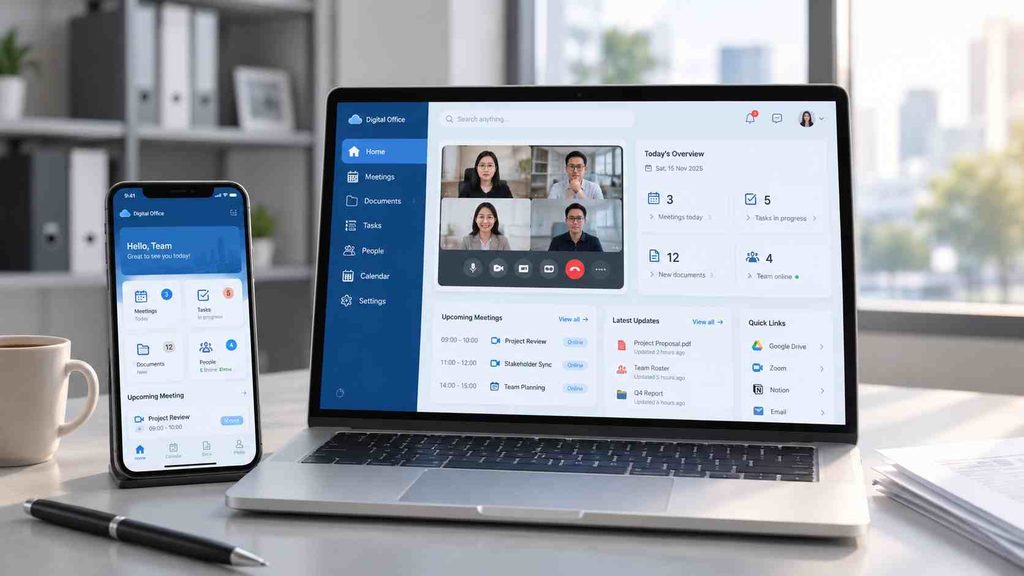
A Digital Workplace is a work environment built on technology platforms that enable employees to communicate, exchange information, manage documents and collaborate in a unified digital space. Instead of relying on individual emails, personal group chats, disconnected spreadsheets and documents stored across multiple devices, businesses can organize internal activities within a structured system with clearer control and management.
The key to a Digital Workplace is not how many software applications a business uses, but how these tools are connected to support daily work. Employees can receive information, communicate with colleagues, access documents, assign tasks and track progress without constantly switching between multiple disconnected channels.
For example, when the Sales Department needs to work with the Marketing Department to prepare a sales campaign, information about the plan, documents, deadlines and assigned personnel should be centralized in one place, where all relevant parties can access it according to their permissions. When changes occur, participants can update and track information using the same source rather than searching through multiple conversations.
Therefore, a Digital Workplace is not simply about moving office activities online. It is a way for businesses to establish an organized working environment in which information is shared with proper controls, responsibilities are clearly defined and collaboration does not depend excessively on manual communication.
Why Should Businesses Standardize Internal Communication Before Implementing CRM and ERP?
CRM and ERP are often considered important systems in the digital transformation process. CRM supports customer relationship management, sales activities and customer service. ERP helps connect operational activities such as finance, accounting, purchasing, inventory and manufacturing. However, both systems need an organized operational foundation to deliver their full value.
A common problem in many businesses is that internal information remains scattered. Work requests are sent through personal messages, documents are stored in different folders, decisions are discussed but not recorded in a central location, and progress depends on individual employees proactively providing updates. As the workforce grows, this approach makes collaboration more complicated and difficult to control.
If a business implements CRM while customer information, interaction histories and responsibilities across departments are not managed consistently, it may continue to experience incomplete or inconsistent data. Sales representatives update information in one place, the customer service team records it elsewhere, while managers have to consolidate everything manually to obtain a complete picture.
Similarly, ERP can help standardize operational processes, but it cannot automatically resolve problems related to communication, task handovers and responsibilities between departments. If employees are not familiar with using a shared system, updating data and following processes, implementation may encounter obstacles even when the software meets technical requirements.
Therefore, standardizing internal communication is an important preparation step. Once employees have developed the habit of working in a unified environment, businesses will find it easier to move specialized processes such as sales, customer service and operational management onto CRM or ERP systems.
Which Activities Should a Digital Workplace Standardize?
An effective Digital Workplace does not necessarily need to include many complex features from the outset. Businesses should start with activities that are used frequently and directly affect the ability of departments to collaborate.
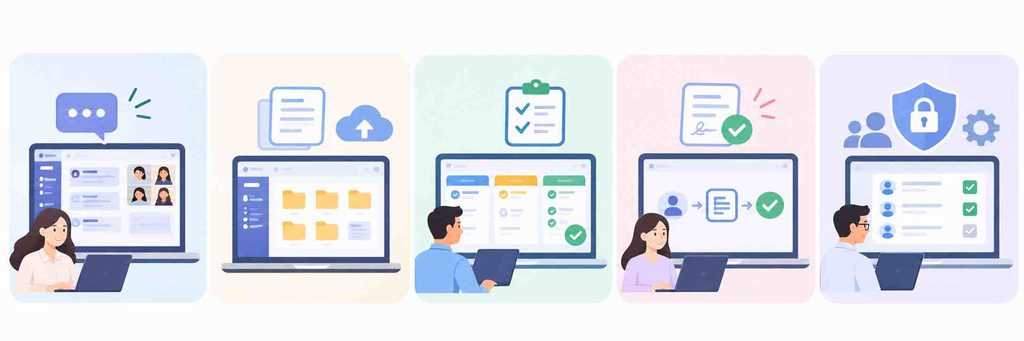
Internal communication and collaboration: Announcements, work discussions and coordination activities should be organized through appropriate shared channels. Employees need to know where to communicate, which information needs to be recorded and who is responsible for responding. This helps prevent important information from getting lost in personal conversations.
Document and information management: Documents should be stored according to a consistent structure, with clear rules for naming, version control and access permissions. When an employee needs to find a contract, report or project document, they should be able to identify its storage location and use the correct version currently in effect.
Task assignment and tracking: Each task should have a clearly assigned owner, deadline and status. Instead of assigning work only through messages, businesses should establish a way to record and track tasks so managers can see what stage each task has reached, whether it is delayed or whether support is needed.
Internal approval and request processing: Activities such as leave requests, expense proposals, purchasing requests or document approvals can be organized through clearly defined workflows. Employees who submit requests can see who is handling them, managers can monitor their status and approval histories can be recorded for future reference.
Account and access management: Businesses need to define which employees can use the system and what types of data they can view or edit. When new employees join, change positions or leave the company, their access permissions need to be updated accordingly to protect internal information.
These are the foundations that help businesses establish a consistent way of working. When these activities are well organized, data and specialized processes in subsequent stages of digital transformation will have better conditions for stable operation.
From Digital Workplace to CRM and ERP: A Connected Digital Transformation Roadmap
A Digital Workplace, CRM and ERP are not competing systems or alternatives to one another. Each solution serves a different role in business operations. A Digital Workplace focuses on the working environment and internal collaboration; CRM manages customer relationships; and ERP connects and controls core operational processes.
Businesses can visualize the implementation roadmap through three connected phases.
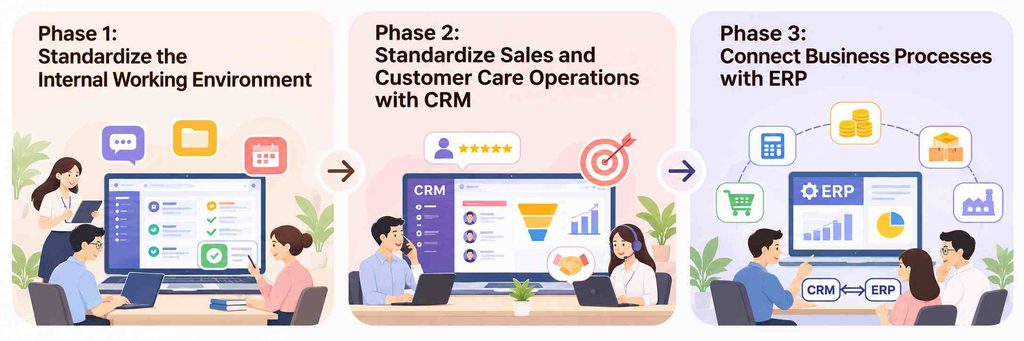
Phase 1: Standardize the internal working environment. Businesses establish platforms for communication, document storage, task management and approvals. The goal is to reduce information fragmentation, clarify responsibilities and develop the habit of working through a shared system.
Phase 2: Standardize sales and customer service activities using CRM. Once internal information and collaboration practices have been established, businesses can focus on managing customer data, tracking sales opportunities, maintaining interaction histories and developing customer service processes. Relevant departments also need to agree on how data is recorded and updated to avoid creating separate information sources.
Phase 3: Connect operational processes using ERP. When businesses need greater control over activities such as finance, accounting, inventory, purchasing or manufacturing, ERP can be implemented to connect data and processes across departments. Integration with CRM allows information from sales activities to be linked with corresponding operational processes.
This sequence is not a mandatory formula for every business. Some organizations may need to implement CRM or ERP earlier due to urgent business requirements. However, regardless of which system is chosen first, businesses still need to assess their readiness in terms of data, processes and employees’ ability to collaborate. These are the factors that determine whether a system will be used properly and deliver practical value.
Where Should Businesses Start When Building a Digital Workplace?
Instead of implementing multiple tools simultaneously, businesses should begin by evaluating how employees currently work. They need to identify which channels are used to exchange information, where documents are stored, how tasks are assigned and tracked, and which approval steps still depend on manual processing. This assessment helps identify activities that cause delays and inconsistencies in internal operations.
Next, businesses need to establish working principles before selecting technology platforms. For example, they should define communication channels for different types of work, document naming and storage conventions, responsibilities for updating progress, approval workflows and data access permissions. Without these principles, introducing new tools may simply move old habits into a different environment.
After identifying their needs, businesses can select solutions that match their organizational size and level of complexity. The chosen platform should meet essential requirements, be easy to use, offer scalability and support integration with other systems as the business grows.
Finally, businesses need a plan for user guidance and evaluating actual adoption. The effectiveness of a Digital Workplace is not measured solely by the number of accounts created or software applications implemented. It is also reflected in the ability to find information, task processing time, the level of collaboration between departments and compliance with shared processes.
Standardize the Way People Work Before Standardizing Business Processes
CRM and ERP can help businesses manage customers and operate more efficiently, but technology cannot automatically change how employees communicate, share information and take responsibility for their work. If the foundation for internal collaboration remains inconsistent, old problems may continue to appear in new systems.
A Digital Workplace is therefore an important preparation step in the digital transformation journey. When businesses establish a unified working environment, manage information clearly and develop the habit of collaborating through a shared system, CRM and ERP implementation will have a stronger foundation for achieving long term results.
WBLGroup works alongside businesses to assess their current state, standardize internal activities and select suitable technology solutions, helping them build a connected and practical digital transformation roadmap that meets their actual development needs.