









CRM System Architecture should not be designed only to solve today’s challenges. A business may start with a few Sales employees, a simple process and a limited amount of Data, but after a few years, it may have multiple teams, multiple processes, multiple Data sources and completely different management requirements. Therefore, if CRM is viewed as a 5 year journey, the important question is not “Is the system enough today?”, but “How far can this system go with the business?”

Year 1: Build the Foundation So Data Is No Longer Scattered
Let’s start with the first year, when the business is still in the foundation building stage.
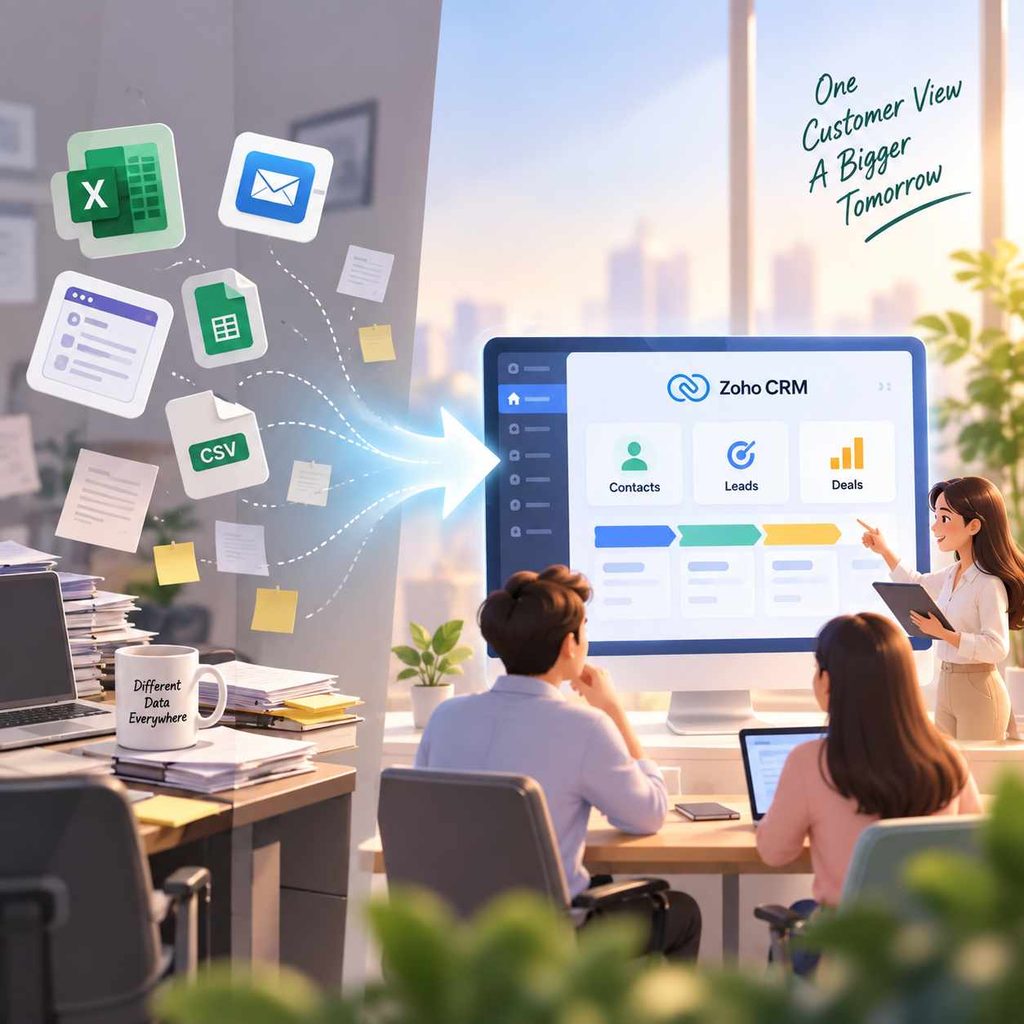
At this point, the problem is usually not a lack of technology, but the fact that Data is spread across too many places. Customer information may exist in Excel, Email, Website Forms or individual files used by each employee. Sales knows its customers, but the business may not yet have a complete picture of all its customers.
This is when CRM System Architecture needs to start with the most basic components: customer information, Leads, Sales opportunities and processing workflows. The goal is not to build a very large system, but to bring important Data into a structured environment so the team can begin working in a consistent way.
Zoho CRM is currently positioned by Zoho as a platform that can manage Leads, Contacts and Deals within a unified system, replacing fragmented management through spreadsheets, Emails and separate notes.
If the first year is done well, the business will have an important foundation: Data begins to be centralized and can continue to develop together with the system.
This is also the stage when businesses need to avoid a common mistake: putting everything they currently have into CRM without first determining which Data is actually necessary. A good system does not start with a large number of information fields, but with the Data that directly supports how the business is currently selling.
Year 2: Standardize So the Team No Longer Works in Its Own Way
Once the system has Data, the next step is standardization.
At this point, businesses begin to realize that having a CRM does not mean everyone is using the CRM in the same way. One Sales employee may update Leads very thoroughly, while another only records a few basic details. One team may have a clear customer follow up process, while another handles customers based on individual experience.
If this situation continues, Data may still be centralized but can lack consistency.
The second year should therefore focus on processes and Data quality. Businesses need to clearly define where a Lead enters the system, when it becomes an opportunity, what information needs to be updated at each stage and who is responsible for each step.
Once the process is clear, CRM can begin to play a management role instead of simply serving as a place to store information.
Zoho CRM provides various tools that allow businesses to customize modules, Data fields, Pipelines and processes according to their actual organizational structure. Tools such as Blueprint can also be used to control the steps within the Sales process.
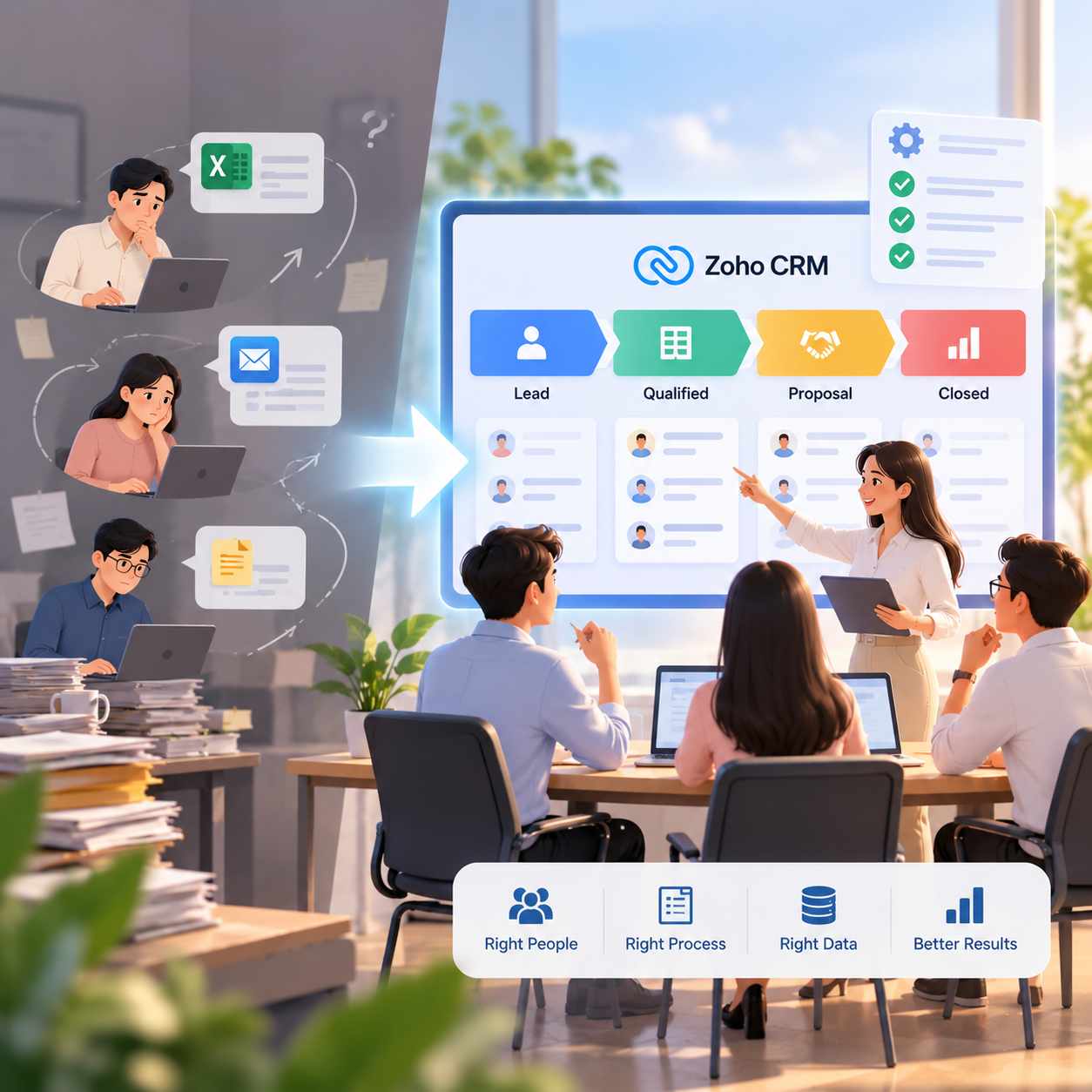
This is the point when Data moves from “being recorded” to “being managed according to a common structure.”
And when the team begins working on the same structure, the business can start measuring performance more reliably.
Year 3: Optimize When CRM No Longer Serves Sales Alone

By the third year, the business may have accumulated enough Data to begin seeing issues that were not clear before.
Where do Leads come from? Which stage in the Pipeline is usually delayed? Which Sales team is performing effectively? Through which touchpoints have customers interacted with the business? These questions are no longer relevant only to Sales.
CRM begins to become a place that connects more activities.
Marketing needs to know which sources generate quality Leads. Sales needs to know which opportunities should be prioritized. Customer care needs to see interaction history. Management needs Data to evaluate the Pipeline situation and team performance.
This is when CRM System Architecture needs to be designed around connection rather than simply increasing the number of users.
Zoho CRM currently supports connections with many applications within the Zoho ecosystem as well as external applications, while also providing customization and automation tools so the system can better fit different processes.
Once repetitive steps have been identified, businesses can continue automating suitable tasks. Activities such as assigning Leads, sending notifications, updating Data fields or triggering the next processing step do not necessarily have to depend entirely on manual actions.
This is the stage when CRM begins to shift from a management tool into part of the operating system.
Year 4: Scale When the Business Begins to Have More Complex Requirements
Entering the fourth year, the business may no longer have only one Sales team and one Sales process.
There may be multiple products, customer groups, markets or separate processes for different activities. At this point, a rigid CRM structure will begin to create limitations. The more the business develops, the clearer the need for customization becomes.
This is when CRM System Architecture needs to be reviewed at a broader level: what types of Data is the system managing, which departments are using it, how is Data between groups related and which processes need to be connected.
Zoho CRM allows businesses to create additional custom modules, add Data fields, set access permissions, build multiple Pipelines and connect modules with one another. These capabilities allow the CRM structure to change according to business needs instead of forcing the business to completely change the way it operates to fit the system.
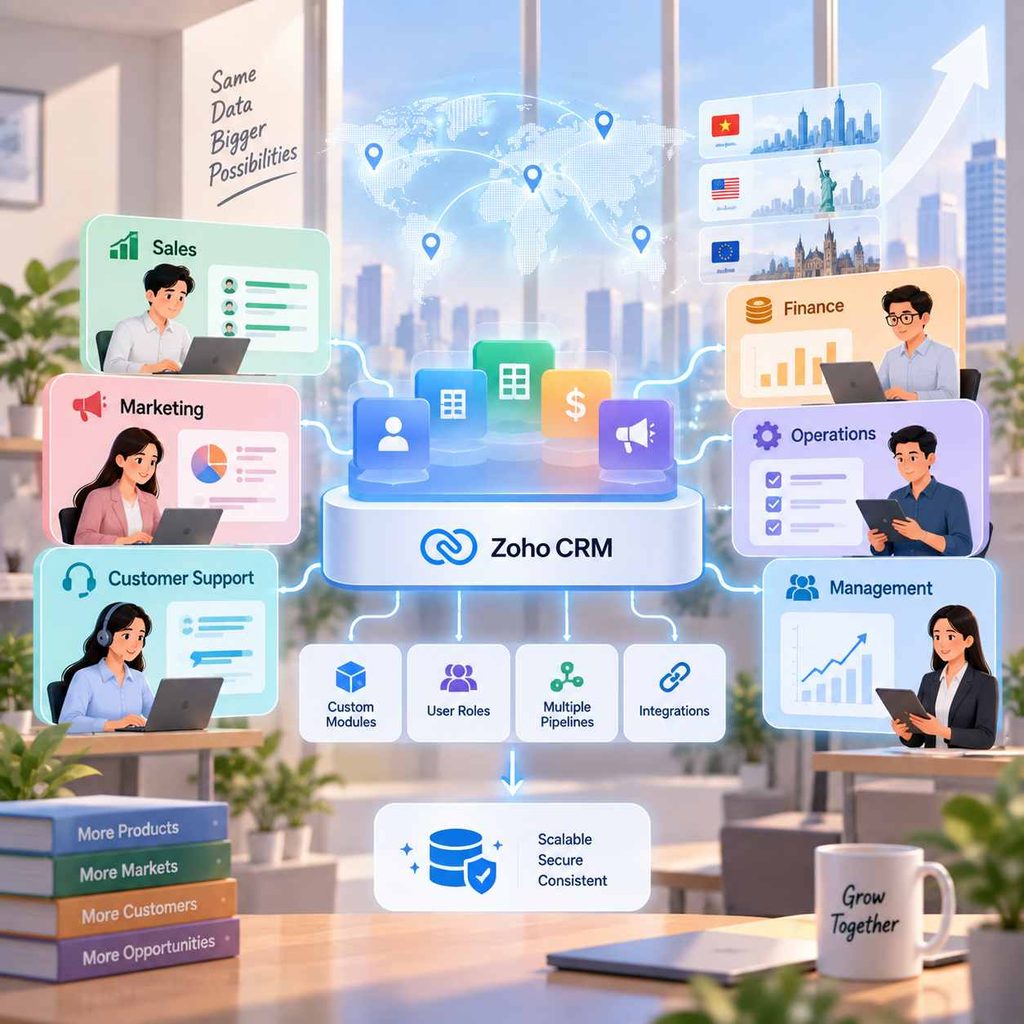
As the scale becomes larger, security and access permissions also become more important. Not every employee needs to see all Data. Not every department needs to use the same interface or the same type of information.
A scalable system is therefore not simply a system with more features. It is a system that can change its structure while maintaining the consistency of Data and processes.
Year 5: From Data Management to Creating an Advantage for Growth
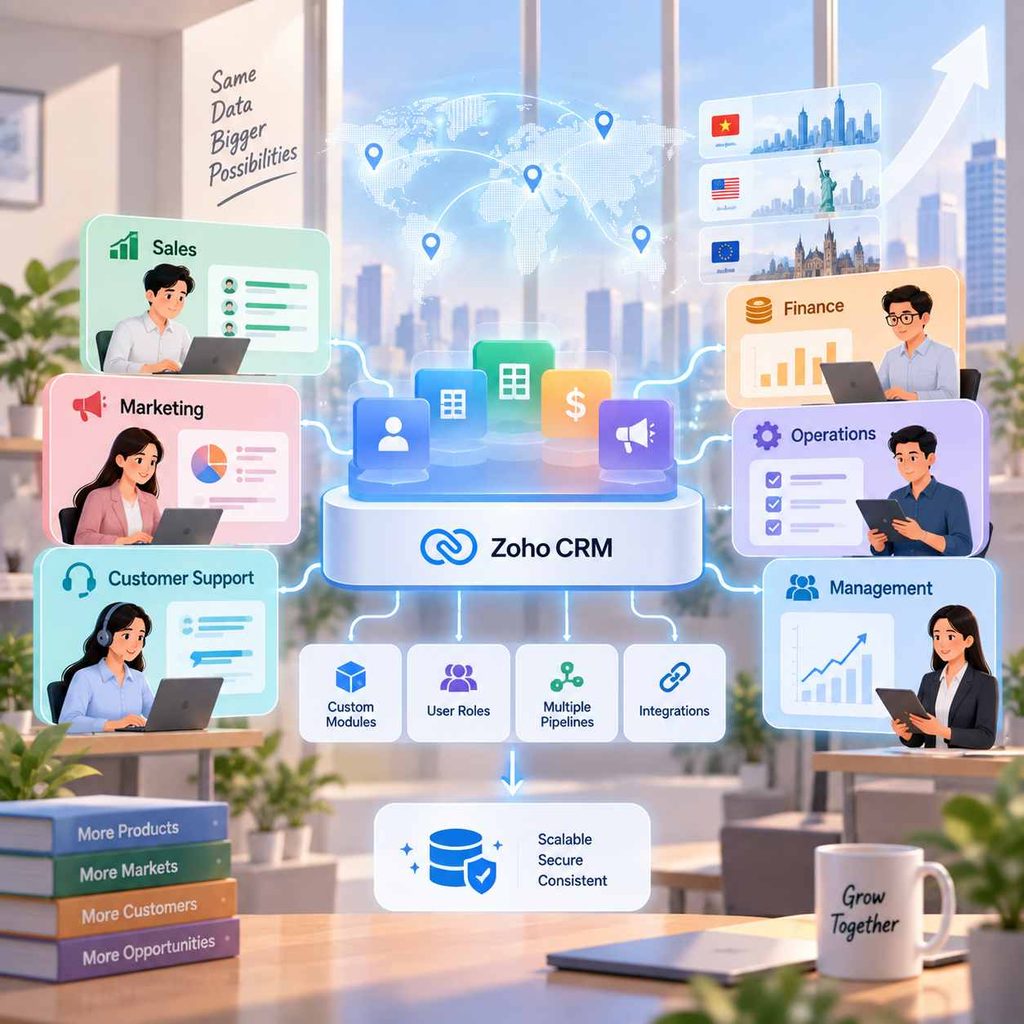
By the fifth year, the business should no longer view CRM simply as a place to store customers or manage Pipelines.
After years of accumulation, Data begins to have greater value. The business has transaction history, customer behavior, Lead sources, Sales performance and Data from many other activities. The question now shifts from “How much Data do we have?” to “What can we do with this Data?”
This is when the CRM system can become a foundation for more strategic decisions.
Zoho CRM currently integrates analytics, reporting and AI capabilities such as Lead scoring, outcome prediction and data based recommendations, depending on the edition being used. When analytical needs extend beyond Sales Data, Zoho Analytics can be connected with CRM to build more in depth reports and dashboards.
At a more advanced level, businesses can also extend CRM through development tools and connections with other systems. Zoho CRM provides APIs, SDKs, Functions and extension tools to handle requirements beyond the available built in functions.
At that point, CRM no longer only answers the question “Where is the customer in the Pipeline?” but begins to support larger questions about growth, performance and how the business uses Data to make decisions.
That is the final point of a 5 year journey: from centralizing Data, to standardizing, optimizing, scaling and ultimately leveraging Data to support strategy.
A Good CRM System Must Grow with the Business
Looking back at the entire journey, the first year and the fifth year can be completely different.
In the first year, the business only needs to know where customers are and which opportunities Sales is handling. The second year requires a standardized process. The third year begins connecting multiple departments. The fourth year requires customization to support specific business requirements. By the fifth year, Data has become a resource for analysis and decision making.
This is why CRM System Architecture should be viewed from the future rather than only from current needs.
This does not mean businesses need to build a complex system immediately to serve needs that do not yet exist. On the contrary, a good architecture needs to be simple enough to implement today but flexible enough to scale as the business changes.
A CRM with long term growth capability needs at least four foundations: a clear Data structure, customization capabilities, connectivity and process scalability. Zoho CRM is built with the ability to customize everything from modules, Data fields and Pipelines to automation, integrations and deeper extension tools.
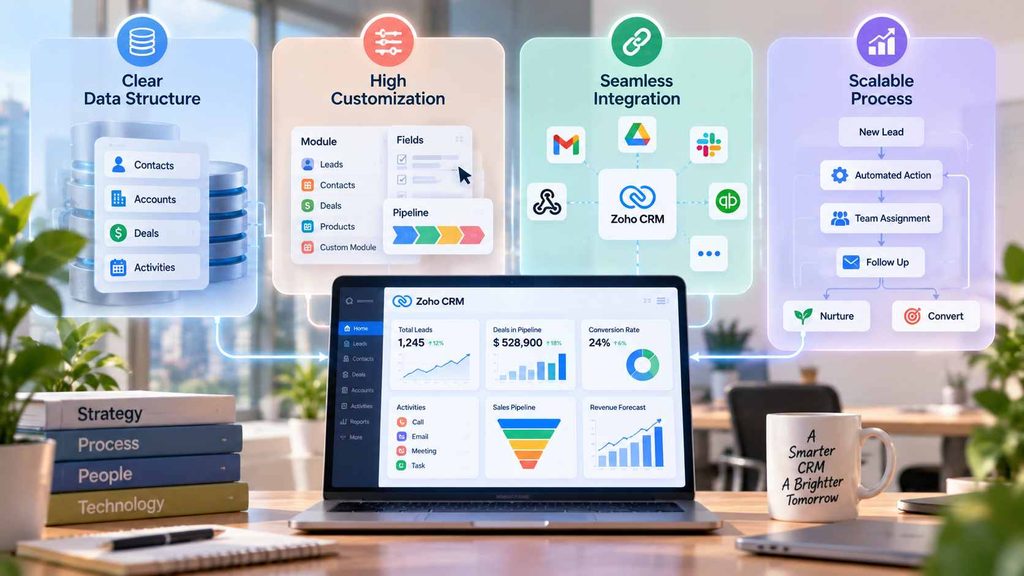
For WBLGroup, building a CRM should therefore not begin with the question, “What features does the business need today?” The more important question is “What does the business want to become over the next 5 years, and how does the Data system need to change to support that journey?”
A system built correctly from the foundation will not need to be continuously replaced every time the business grows. It can be expanded, adjusted and connected further at each stage.
A good CRM does not only manage the present. A good CRM must be flexible enough not to become a limitation on the future.