










A Real Estate CRM does not help you generate more leads. It helps you avoid losing the ones you already have. As customer acquisition costs continue to rise, losing existing leads has become one of the main reasons many real estate businesses lose their competitive advantage. Every lead represents an investment, whether it comes from advertising campaigns, property launch events, referral partners, or the sales team. Yet many valuable opportunities are still lost simply because customer follow up is inconsistent or does not happen at the right time.

In reality, most buyers in the real estate industry do not make a purchasing decision after the first consultation. They need time to research projects, compare different options, evaluate their financial situation, and wait for the right opportunity. Without a structured follow up process throughout the customer journey, potential buyers can easily move to another project or choose a competitor that provides a better customer experience.
This is why Real Estate CRM has become an increasingly important platform for modern real estate businesses. Rather than simply storing customer information, a Real Estate CRM helps organizations manage the entire buying journey, automate customer nurturing activities, and ensure that no sales opportunity is missed throughout the sales process.
Why Do Real Estate Customer Nurturing Funnels Break Down?

Many real estate companies assume they lose customers because of their products or the performance of their sales team. In reality, however, most problems originate from operational processes.
Some of the most common breakdowns include:
- Lead assignment is delayed or routed to the wrong sales representative.
- Sales consultants forget to follow up after a prospect submits an inquiry.
- There is no structured schedule for regular follow up.
- Customer conversations are scattered across Zalo, Excel spreadsheets, and personal mobile phones.
- Managers have no visibility into where customers are in the buying journey.
When these breakdowns occur, businesses lose not only potential customers but also the marketing investment spent on generating those leads.
Real Estate Customer Nurturing Process
An effective Real Estate CRM does more than store customer data. It standardizes the entire customer nurturing journey.
Stage 1. Lead Capture
Every sales journey begins with capturing potential customers. Leads may come from multiple sources, including websites, landing pages, Facebook Ads, Google Ads, property launch events, or referral programs. If customer data is not centralized from the beginning, businesses can easily face duplicate records, delayed lead assignments, or missed opportunities.
With a Real Estate CRM, every lead is automatically captured and stored in a centralized platform. Based on predefined business rules, the system can automatically assign leads according to location, project, lead source, or sales representative. As a result, every lead reaches the right salesperson immediately, reducing response time, minimizing missed opportunities, and improving conversion potential.
Stage 2. Initial Consultation
Once a lead has been assigned, response speed becomes one of the most important factors in creating a strong first impression. Delayed follow up or missing the moment when customers are actively interested can significantly reduce the likelihood of conversion.
As soon as a lead enters the system, the Real Estate CRM can automatically generate follow up tasks such as phone calls, confirmation emails, or text messages. Every phone call, email, note, and appointment is recorded within a single customer profile. This allows any member of the sales team to continue the consultation process seamlessly without losing valuable customer information.
Stage 3. Lead Nurturing
In the real estate industry, customers rarely make a purchasing decision after the first consultation. They need time to explore different projects, compare available options, evaluate their financial capacity, and wait for the right opportunity. This is also the stage where many businesses unintentionally lose potential customers because they fail to maintain consistent and strategic communication.
With preconfigured automation workflows, customers receive relevant content based on where they are in the buying journey. The system can:
- Send information about suitable projects.
- Share updated policies and promotions.
- Send appointment reminders.
- Deliver greetings on special occasions.
- Track customer engagement and interactions.
This allows the business to maintain a consistent presence throughout the buying journey without overwhelming customers. At the same time, it helps the sales team identify the right moment to reconnect and improve the likelihood of conversion.
Stage 4. Closing the Deal
When customers reach the decision making stage, tracking progress and coordinating across departments becomes especially important. Even a small delay or missing information can negatively impact the customer experience and slow down the transaction.
Every step of the process, from negotiations and contract management to payment schedules and pre signing tasks, is managed within a single system. This enables the sales team and related departments to monitor progress, collaborate more efficiently, and minimize errors during the closing process.
In addition to supporting daily operations, the system updates data in real time, allowing managers to monitor conversion rates by salesperson, project, or lead source. These insights provide a solid foundation for evaluating sales performance, identifying process bottlenecks, and making timely business decisions.
Stage 5. Post Sales Customer Care
Closing a deal is not the end of the customer journey. It marks the beginning of a long term relationship. In the real estate industry, customers who have successfully completed a transaction often have a higher level of trust and may return for future purchases, investment opportunities, or referrals.
After a transaction is completed, post sales nurturing programs can be automated based on different stages of the customer lifecycle. The system can send updates about new projects, notify customers of special offers, schedule regular follow ups, and manage customer appreciation or referral programs. Every interaction is stored in a centralized customer profile, making it easier for the sales team to maintain communication, strengthen relationships, and deliver a more personalized customer experience.
These customers represent one of the most valuable business assets. Their acquisition cost is significantly lower than attracting new prospects, while their lifetime value is much higher. Beyond making future purchases, they can also become a reliable source of referrals, helping the business grow its customer base sustainably.
Automation Helps Sales Create More Value
One of the most common misconceptions is that automation will replace the role of the sales team. In reality, technology cannot replace people when it comes to consulting, building relationships, or negotiating with customers. Instead, a Real Estate CRM takes over repetitive and time consuming tasks, allowing sales professionals to focus on activities that create real value.
Routine tasks such as lead assignment, follow up reminders, opportunity status updates, automated email campaigns, and report generation can all be automated. As a result, sales representatives spend less time on administrative work and more time understanding customer needs, building trust, and improving closing rates.
For managers, automation also provides real time visibility into team performance, enabling data driven evaluations and helping identify areas for improvement within the sales process. When technology handles repetitive tasks, sales teams gain more time to focus on what people do best: building meaningful relationships and delivering a high quality consulting experience.
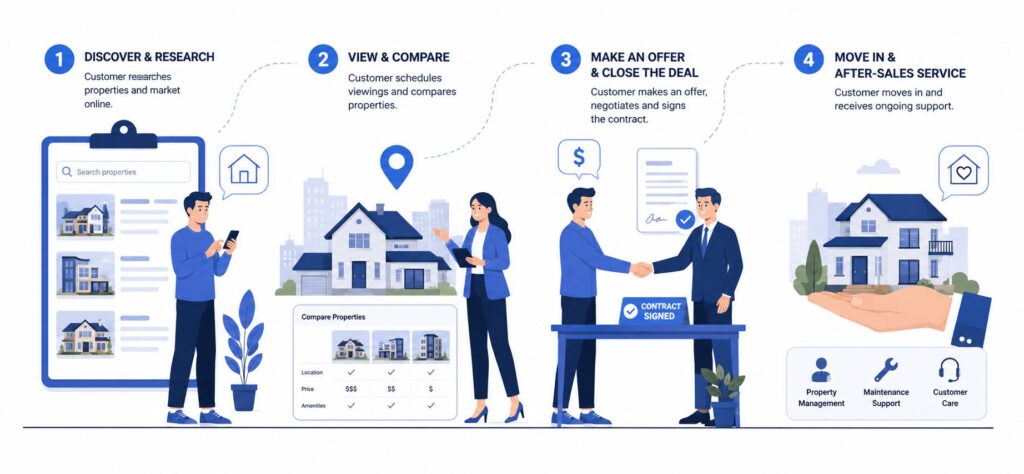
A Real Estate CRM Is Only Effective When Built on the Right Process
Many businesses implement a Real Estate CRM but fail to improve sales performance because they focus only on the software instead of standardizing their customer nurturing process.
A Real Estate CRM is not a solution to every business challenge. It is a tool that digitizes and automates a process that has already been designed correctly. If the process itself is unclear or inefficient, implementing CRM simply allows those weaknesses to happen faster.
At WBL Group, we begin by analyzing how each business operates. We then redesign the customer nurturing funnel based on the unique characteristics of the company’s real estate business model before implementing the CRM platform and its corresponding automation workflows.
Our objective is to build a seamless customer nurturing process first, then use CRM technology to automate operations, reduce lost opportunities, and improve conversion performance.
If your business is struggling with lead management, customer follow up, or building an effective Real Estate CRM strategy, contact WBL Group. Our consultants will help you design a CRM solution that aligns with your business model and long term growth strategy.