










Real Estate OKRs are more than simply setting sales targets for the Sales team. Their real value lies in helping businesses monitor the entire sales process through data, enabling managers to make operational decisions based on facts rather than intuition.
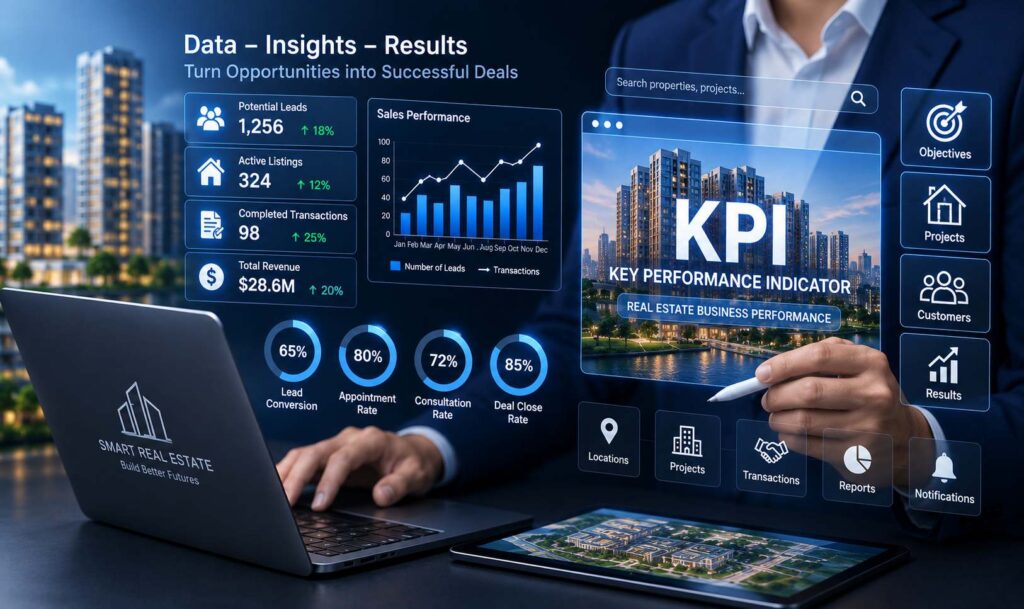
How Are Real Estate OKRs Different from Traditional KPIs?
In many real estate businesses, Sales performance is still evaluated primarily based on monthly revenue. When sales meet expectations, everything appears to be running smoothly. However, when revenue declines, managers often struggle to identify the real cause.
Is the Sales team responding to customers too slowly? Is the quality of the leads insufficient? Or is there a bottleneck somewhere within the customer nurturing process?
If businesses focus only on revenue, they only see the final outcome rather than the entire journey that produced that result. As a result, many management decisions continue to rely on experience or instinct instead of operational data.
This is why more and more organizations are moving beyond traditional KPI management and adopting Real Estate OKRs built on continuously updated CRM data.
Real Estate OKRs Are More Than Sales Targets
One of the most common misconceptions is that OKRs simply involve setting a revenue target and evaluating results at the end of a reporting period.
In reality, OKRs help businesses measure the activities that create results. Instead of looking only at how many properties Sales representatives have sold, managers need to understand what activities the team is performing, how sales opportunities are progressing, and where bottlenecks are appearing within the process.
This is particularly important in the real estate industry, where a single transaction may take weeks or even months to complete. If businesses wait until the end of the month to evaluate performance, they miss the opportunity to make adjustments as soon as the sales process begins to slow down.
What Should an Effective Real Estate OKR Framework Measure?
For Real Estate OKRs to accurately reflect operational performance, businesses need to monitor metrics throughout the entire sales journey instead of focusing only on the final result. Every lead passes through multiple stages before becoming a successful transaction, and each stage should be measured using data rather than assumptions.
A typical real estate sales process can be illustrated as follows:
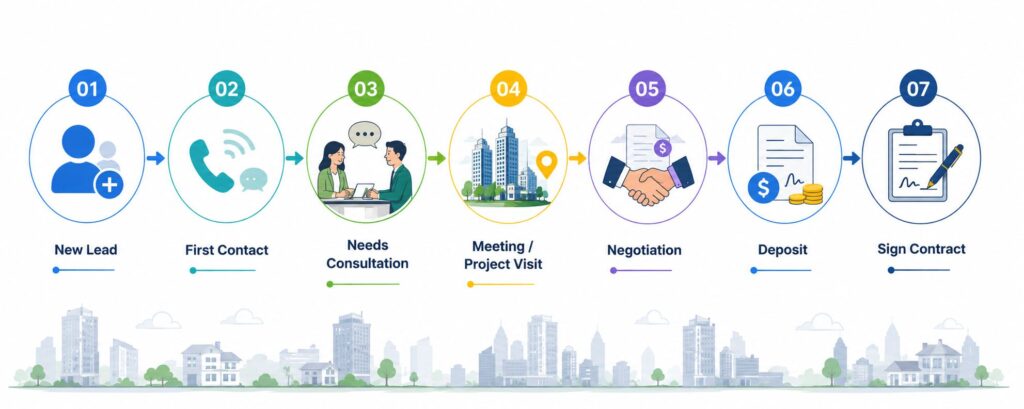
At every stage, businesses can monitor different performance metrics to evaluate both individual Sales performance and the effectiveness of the overall sales process.
1. Lead Response Speed
Real estate customers often contact several companies at the same time. As a result, response time plays a critical role in creating a strong first impression and maintaining the opportunity to close the sale.
Instead of simply counting how many leads are assigned to Sales representatives, businesses should measure the percentage of leads contacted within their target response time.
2. Conversion Rate at Each Stage of the Lead Pipeline
A lead does not automatically become a successful transaction. Every prospect moves through multiple stages, including consultation, appointment scheduling, property visits, negotiations, and deposit confirmation.
If businesses only monitor the number of closed deals, it becomes difficult to identify which stage is reducing the overall conversion rate.
Tracking conversion rates between each stage allows managers to quickly identify bottlenecks within the sales process and take appropriate action.
3. Sales Activity Completion
In the real estate industry, maintaining consistent customer engagement is just as important as acquiring new leads.
An effective Real Estate OKR framework should monitor activities such as the number of completed phone calls, appointments conducted, and customer follow ups carried out according to plan.
These metrics reflect how proactively the Sales team is engaging with customers and allow businesses to evaluate performance based on the sales process rather than relying solely on final sales results.
4. Performance by Lead Source and Project
Not every lead source delivers the same conversion rate. Likewise, each real estate project has its own sales cycle and level of customer interest.
Tracking performance by lead source, project, and marketing campaign enables businesses to optimize marketing budgets while allocating Sales resources more effectively.
How Does Zoho CRM Help Track Real Estate OKRs?hế nào?
One of the biggest challenges when implementing Real Estate OKRs is that sales data is often scattered across multiple tools. Sales teams update their progress in Excel, Marketing manages leads on another platform, and managers have to consolidate information manually before evaluating performance.
With Zoho CRM, all sales data is centralized within a single platform. From new leads and customer interaction history to opportunity progress and conversion rates, every piece of information is updated in real time.
This enables managers to monitor the performance of individual Sales representatives, projects, or lead sources without waiting for end of month reports. More importantly, because data is captured continuously throughout daily operations, Real Estate OKRs become more transparent, objective, and data driven.
Measure to Improve, Not to Control
An effective Real Estate OKR framework is not designed to create additional pressure for the Sales team. Its purpose is to help businesses understand what is happening throughout the sales process so improvements can be made at the right time.
When data is updated continuously, managers can quickly identify early warning signs such as slow lead response times, declining conversion rates, or customer nurturing activities falling behind schedule. These insights provide the foundation for supporting the Sales team, optimizing workflows, and improving performance before revenue is affected.
Performance management is no longer about evaluating results after everything has already happened. It is about supporting the team throughout the entire journey toward achieving business objectives.

Real Estate OKRs Are Only Effective When Data Is Standardized
Many businesses create detailed Real Estate OKRs but still struggle during implementation because operational data is incomplete or inconsistent across departments.
For OKRs to accurately reflect business performance, organizations need both a clearly defined sales process and a CRM system capable of capturing data throughout every stage of daily operations.
At WBL Group, we do more than implement Zoho CRM. We work alongside businesses to standardize sales processes, build meaningful performance metrics, and design management dashboards tailored to different roles across the organization.
When data is standardized and continuously updated, Real Estate OKRs become much more than monthly reporting metrics. They become a management framework that gives leaders complete visibility into the sales process, enables faster decision making, and supports the development of high performing sales teams based on data rather than intuition.