








As businesses expand into new markets, acquire more customers and develop multiple business units, a standard CRM system may no longer fully meet their management needs. The challenge is no longer just storing more data, but also connecting information from multiple sources, controlling access permissions, standardizing processes and providing a unified view of customers across the entire organization.
This is when businesses need to consider moving from standard CRM to Enterprise CRM. For organizations with complex processes, multiple departments or plans for rapid expansion, Salesforce is a platform worth considering thanks to its configuration, scalability and ability to integrate with existing technology systems. The value of this transition does not lie in using bigger software, but in turning fragmented data into a foundation for better business decisions.
Why Might Standard CRM No Longer Meet the Needs of a Growing Business?
Standard CRM is generally suitable for businesses with relatively simple Sales processes, lean teams and a limited number of customer touchpoints. The system helps store contact information, track Sales opportunities and manage customer care activities. In the early stages, these functions may meet most operational needs.
However, as businesses add branches, brands, markets or Sales teams, data complexity also increases. Customer information may be scattered across multiple systems, each department may use its own classification methods, and processes may not be consistent. A customer working with several business units within the same group may be recorded in multiple profiles, making it difficult for the business to gain a complete picture of transaction history and actual customer needs.
The issue also extends to control. With multiple user groups, businesses need to assign permissions by role, manage approval workflows and ensure that data is used for the right purposes. If the system lacks flexibility, teams may have to rely on spreadsheets, manual tasks or separate tools to handle requirements that their current CRM cannot support.
This does not mean standard CRM is ineffective. The issue is that the system’s suitability has changed as the organization has become more complex. When coordination costs, data processing efforts and the maintenance of fragmented solutions continue to increase, businesses need to assess whether their current CRM architecture can still support the next stage of growth.
How Does Enterprise CRM Differ from Standard CRM?
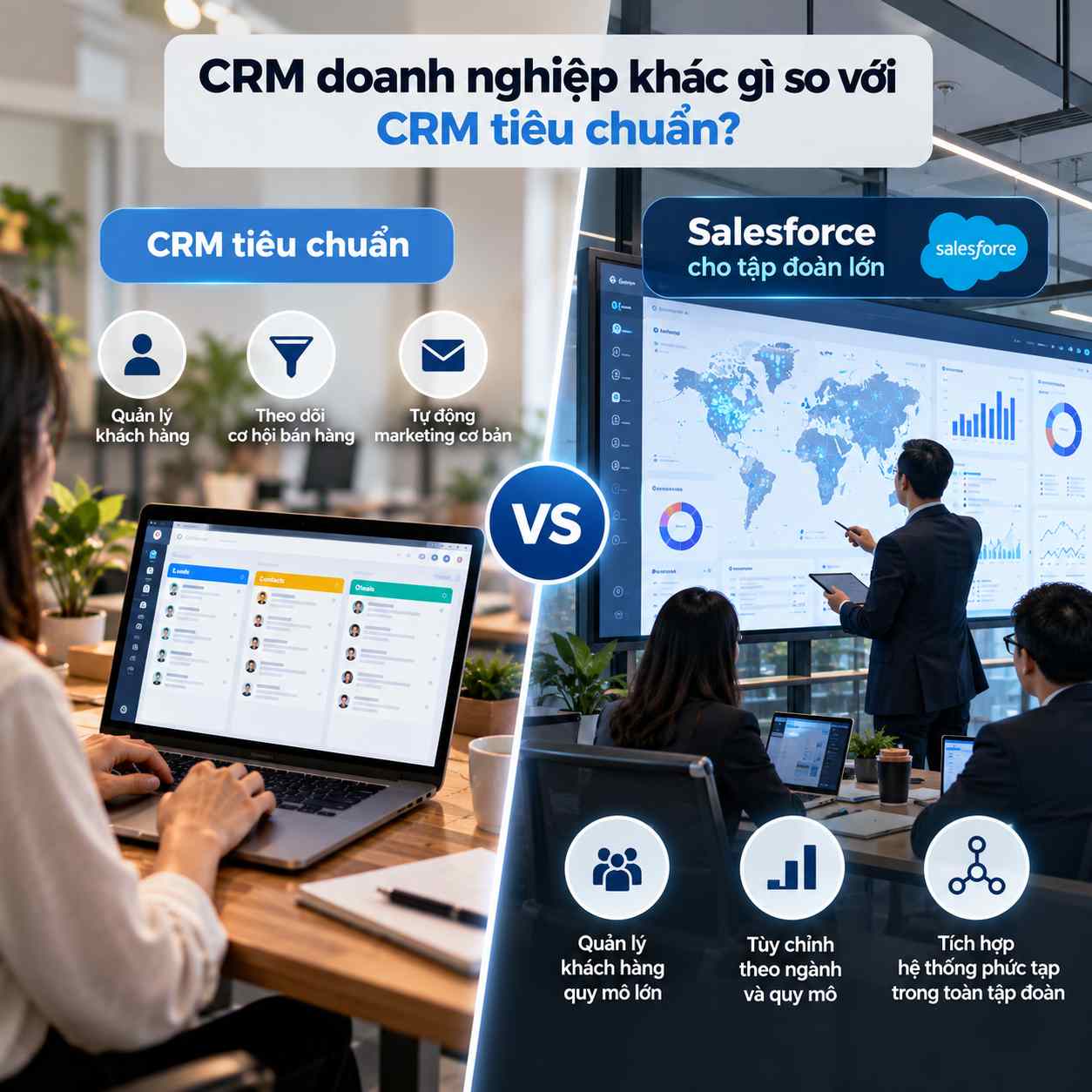
The fundamental difference between standard CRM and Enterprise CRM lies in their ability to meet an organization’s scale, complexity and management requirements. Standard CRM typically focuses on common activities such as contact management, Sales opportunity tracking and customer care. Enterprise CRM, by contrast, needs to support multiple user groups, cross-departmental workflows, complex access control models and integration with existing operational systems.
For large enterprises, customer management is not solely the responsibility of the Sales team. Marketing needs to understand customer behavior and interaction history to develop relevant campaigns. Customer service needs access to previous transactions to provide consistent support. Business leaders need to monitor performance across business units without waiting for data to be manually consolidated from multiple sources.
A well-designed Enterprise CRM system can help departments work with consistent data while maintaining access permissions and workflows tailored to their respective functions. Businesses can also configure the system to fit their operating models, automate repetitive tasks and expand its capabilities as new requirements emerge.
However, the scale of the software does not automatically improve management quality. If data is not standardized or processes remain inconsistent across business units, upgrading CRM may increase costs without delivering proportional benefits. Therefore, businesses need to clearly identify the limitations of their current system before deciding to invest.
How Does Salesforce Help Businesses Manage Data at Scale?
Salesforce is a customer relationship management platform designed to help businesses manage customers, Sales, Marketing and Service within a scalable ecosystem. For organizations with multiple departments, markets or specialized processes, the platform provides capabilities for configuring business processes, automating workflows and integrating data from related systems.
One important benefit is the ability to build a unified view of customers. Instead of allowing each department to manage its own separate set of information, businesses can design how data is collected, updated and used across teams. When implemented correctly, Sales teams can track opportunities, customer service teams can access interaction histories, and managers can evaluate performance using more consistent data.
Salesforce also supports workflow automation based on conditions and rules defined by the business. For example, Sales opportunities can be assigned according to region or responsible team, approval requests can follow predefined workflows, and activities requiring follow-up can trigger automatic reminders. This reduces dependence on manual tasks while improving consistency as transaction volumes increase.
In addition, integration capabilities allow Salesforce to connect with applications used for finance, operations, Marketing and customer service. However, the actual level of integration depends on the system architecture, the capabilities of each application and the scope of implementation. Businesses need to define the primary data source, synchronization rules and data management responsibilities to prevent duplicate or inconsistent records.
Salesforce is therefore not only suitable for enterprises that are already large. Businesses preparing for rapid expansion may also consider the platform if their management requirements, integration needs and long-term growth plans are complex enough to justify the investment.
When Should a Business Upgrade to Enterprise CRM?
Not every business needs to move to an Enterprise CRM platform from the outset. If Sales processes are still simple, data is centralized and the team can manage operations effectively with the current system, upgrading too early may create unnecessary costs and additional pressure to change.
Businesses should evaluate an upgrade when clear signs emerge. First, customer data is scattered across multiple departments or systems, making it difficult to consolidate information and track interaction histories. Second, business processes involve multiple approval steps, several responsible teams or complex access control requirements that the current CRM struggles to support. Third, the business repeatedly needs additional tools or custom solutions to work around the limitations of its existing system.
Another sign is that business leaders cannot obtain reliable reports on customer and business performance when making decisions. If each business unit defines metrics differently or spends considerable time reconciling data, the underlying issue may lie in the data management architecture rather than the software’s interface or number of features.
Before choosing Salesforce or another platform, businesses need to define their objectives, priority processes, data integration requirements and Total Cost of Ownership. The assessment should include licensing fees, implementation consulting, integration, data migration, training and long-term operations. This provides a basis for determining whether an upgrade will deliver real value compared with continuing to optimize the existing system.
A Roadmap for Transitioning from Standard CRM to Salesforce
To ensure an effective transition, businesses should not begin by transferring all existing data and processes into the new system. The first step is to assess the current state, identify the issues having the greatest impact on business operations and align implementation objectives among relevant stakeholders. The assessment should clarify the limitations of the current system, which data needs to be standardized and which processes genuinely need to change.
Next, businesses need to establish a consistent data model and governance framework. This includes rules for managing customer information, data classification methods, update responsibilities, access permissions and quality control mechanisms. If the enterprise has multiple business units, it is important to define which data should be managed centrally and which data should remain separate by business unit or market.

Once the design is finalized, businesses can implement the system in phases, starting with high-impact processes whose scope is sufficiently clear for testing. Data migration must be carefully controlled, including data cleansing, reconciliation, completeness checks and validation before the system goes live. At the same time, employees need role-based training to understand the new processes and use the system consistently.
Finally, implementation effectiveness must be measured using specific business metrics, such as Sales opportunity processing time, conversion rates, customer data completeness and report preparation time. These metrics help businesses determine whether the system is genuinely improving operations or has simply changed the tools being used.
Moving from standard CRM to Enterprise CRM is not merely a software upgrade; it is a step forward in how an organization governs data and coordinates operations. Salesforce can be a suitable option for businesses that need to expand customer management capabilities, automate workflows and connect data at scale. WBLGroup works with businesses to assess their current systems, identify requirements and develop a digital transformation roadmap aligned with their growth objectives.